


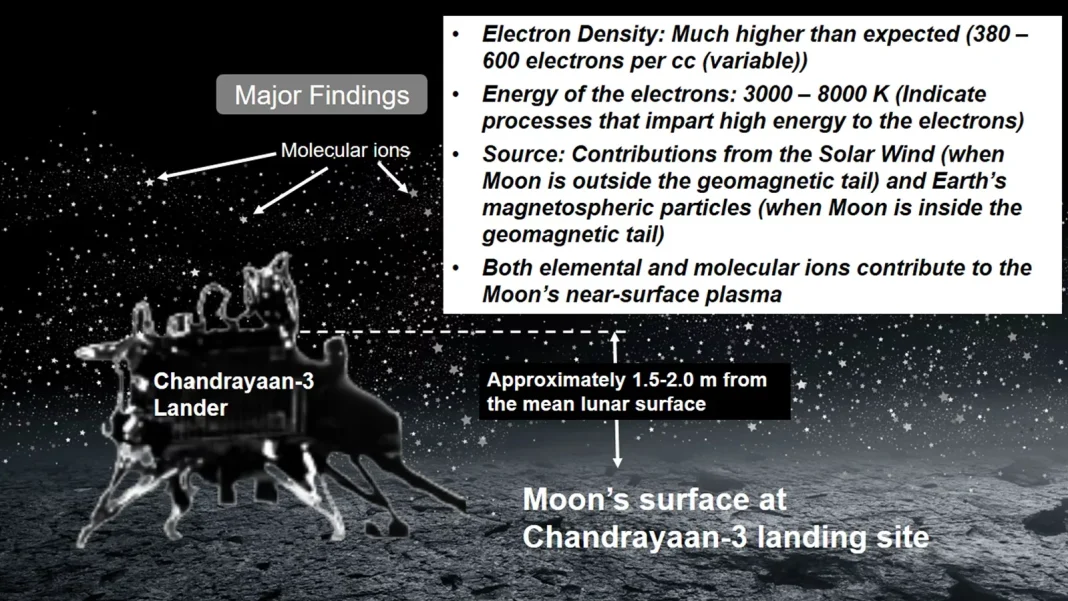
India’s Chandrayaan-3 mission continues to rewrite our understanding of the Moon, with its instruments delivering groundbreaking scientific data. The latest revelation comes from the Vikram lander, specifically its Radio Anatomy of Moon Bound Hypersensitive Ionosphere and Atmosphere – Langmuir Probe (RAMBHA-LP) payload. This advanced instrument has just delivered the most accurate and detailed readings of the lunar plasma environment ever recorded, offering unprecedented insights into our celestial neighbour’s tenuous atmosphere.
The successful soft landing of Chandrayaan-3 in August 2023 marked a historic moment for India, positioning it as the fourth nation to achieve this feat and the first to land near the lunar south pole. Beyond the engineering marvel, the mission’s primary objective has always been scientific exploration. With each passing lunar day, the payloads on board the Vikram lander and Pragyan rover continue to function optimally, transmitting critical data that significantly advances lunar science.
Understanding the Lunar Plasma Environment
Contrary to popular belief, the Moon is not an absolute vacuum. It possesses an extremely thin exosphere, a part of which is comprised of ionized gas known as plasma. This lunar plasma is a dynamic environment influenced primarily by the solar wind – a stream of charged particles emanating from the Sun – and its interaction with the Moon’s surface and weak gravitational field. Studying this plasma is crucial for several reasons.
Firstly, it helps scientists understand the evolution of the lunar atmosphere and the processes that govern it. The density, temperature, and composition of this plasma provide clues about how the Moon interacts with the interplanetary medium. Secondly, accurate knowledge of the lunar plasma environment is vital for future human and robotic missions. Spacecraft operating in this environment can experience electrostatic charging, which can lead to malfunctions or damage to sensitive electronics. Understanding these plasma conditions allows engineers to design more resilient spacecraft and habitats for future lunar settlers.
The RAMBHA-LP payload, meticulously developed by the Space Physics Laboratory (SPL) of Vikram Sarabhai Space Centre (VSSC) at ISRO, is designed to measure the electron and ion densities and temperatures in the lunar near-surface plasma. Its strategic placement on the Vikram lander, post-deployment, ensures direct contact with the lunar surface environment, enabling direct and highly localised measurements.
Unprecedented Precision: A Scientific Leap
The readings transmitted by RAMBHA-LP represent a significant leap in precision compared to previous lunar missions. Past orbital missions have provided broader, regional overviews, but Chandrayaan-3’s lander-based instrument offers direct, in-situ measurements from very close to the lunar surface. This proximity is critical because the plasma characteristics can vary significantly with altitude and local topography.
The data reveals that the near-surface lunar plasma is extremely tenuous, with electron densities ranging from approximately 5 x 10⁶ to 3 x 10⁷ electrons per cubic metre. To put this into perspective, this is vastly lower than the plasma densities found in Earth’s ionosphere. The instrument has also been able to detect minute variations in plasma density, indicative of the Moon’s interaction with the changing solar wind conditions and potentially the local lunar dust environment. These highly sensitive measurements are providing a much clearer picture of the lunar ionosphere’s characteristics during different lunar phases (day vs. night) and solar activity levels.
An ISRO scientist, speaking on the impact of these findings, remarked, “This level of granular detail and accuracy in measuring the lunar plasma has been a long-standing goal for lunar scientists. The RAMBHA-LP data is not just confirming theoretical models, but also revealing subtle nuances that were previously beyond our observational capabilities. It’s a foundational step towards designing truly robust and long-duration missions to the Moon.“ The ability to precisely map these variations is invaluable for modeling the lunar environment and predicting its effects on future hardware.
Implications for Future Lunar Exploration and Beyond
The detailed plasma readings from Chandrayaan-3 have profound implications. For upcoming lunar missions, including India’s own ambitious plans for sustained lunar presence, this data will be instrumental. It will directly inform the design of future landers, rovers, and human habitats, allowing engineers to mitigate risks associated with electrostatic charging and radiation exposure more effectively.
Furthermore, a deeper understanding of the lunar exosphere contributes to the broader field of planetary science. By studying the Moon’s interaction with the solar wind, scientists can gain insights into similar processes occurring on other airless bodies in our solar system, such as asteroids and Mercury. This contributes to our understanding of how planetary bodies evolve and interact with their space environments.
Chandrayaan-3’s continued scientific output reinforces India’s growing stature in space exploration. The mission, initially celebrated for its engineering triumph, is now solidifying its legacy through groundbreaking scientific discoveries that are not only advancing India’s capabilities but also contributing significantly to the global scientific community’s knowledge base about the Moon.
As ISRO prepares for future missions, including the proposed Lunar Polar Exploration Mission (LUPEX) in collaboration with JAXA, the precise data from RAMBHA-LP will serve as a critical baseline, enabling safer, more efficient, and scientifically richer explorations of our nearest celestial neighbour.

