


The universe, in its earliest moments, was a place of unimaginable extremes – a cosmic soup where matter existed in a form radically different from anything we observe today. For decades, physicists have recreated this exotic state, known as the Quark-Gluon Plasma (QGP), in high-energy collisions within particle accelerators. Now, scientists at CERN’s ALICE collaboration have unveiled a groundbreaking discovery that is challenging our fundamental understanding of how this primordial matter forms: evidence of QGP-like behaviour emerging not just from collisions of heavy ions, but surprisingly, even from collisions involving single protons.
This revelation, made at the Large Hadron Collider (LHC) in Geneva, pushes the boundaries of particle physics, suggesting that the conditions required to unleash the universe’s first moments might be less extreme than previously believed. For the scientific community in India and across the globe, this opens a new chapter in our quest to understand the very fabric of existence.
Unraveling the Universe’s Primal Soup
To truly grasp the significance of ALICE’s finding, one must first understand what the Quark-Gluon Plasma is. Imagine a time just microseconds after the Big Bang, when the universe was incredibly hot and dense. At this stage, quarks and gluons – the fundamental constituents of protons and neutrons – were not confined within these particles. Instead, they roamed freely in a superheated, fluid-like state. This is the QGP, often referred to as the ‘primordial soup’ of the universe.
As the universe expanded and cooled, quarks and gluons coalesced to form protons and neutrons, which eventually built atoms, stars, and galaxies. Recreating the QGP in laboratories allows physicists to peek back into this fleeting era. Traditionally, this has been achieved by smashing heavy ions, like lead nuclei, into each other at nearly the speed of light. These energetic collisions generate immense temperatures and pressures, briefly ‘melting’ the protons and neutrons into their fundamental components, producing a tiny, short-lived droplet of QGP.
ALICE’s Groundbreaking Revelation in Proton Collisions
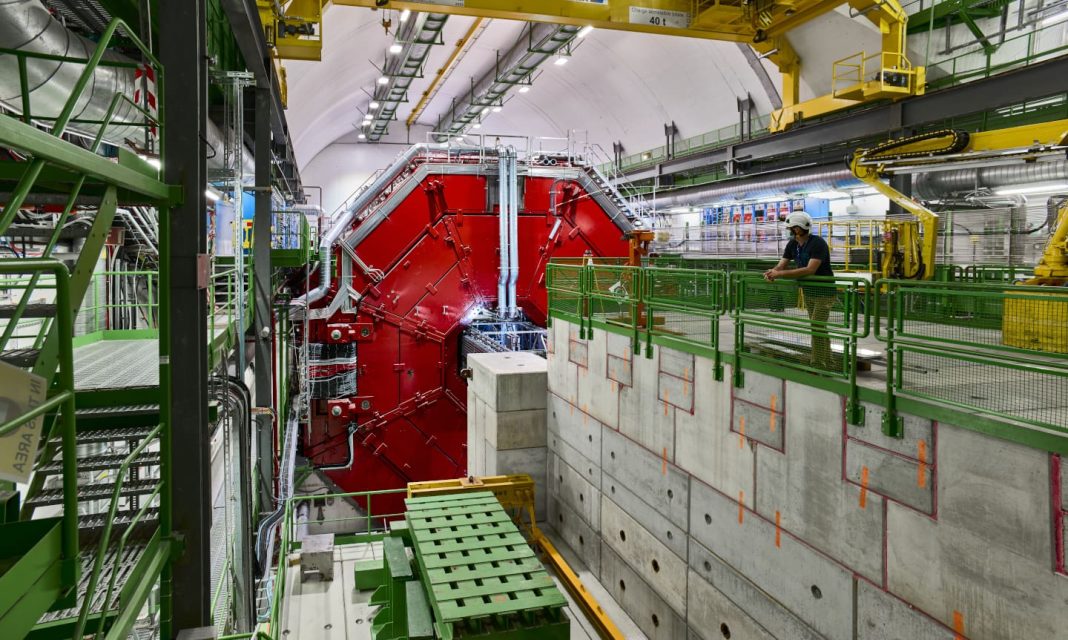
The ALICE (A Large Ion Collider Experiment) collaboration at CERN is specifically designed to study the QGP. While its primary focus has been on heavy-ion collisions, recent analysis of data from proton-proton collisions at the LHC has yielded startling results. Scientists observed “collective behaviour” among the hundreds of particles produced in these seemingly smaller collisions – a phenomenon typically associated with the formation of QGP in heavy-ion interactions.
Specifically, ALICE physicists detected unique patterns in how particles fly apart after a proton-proton collision, which strongly resemble the “flow” patterns seen when QGP is created. This collective motion, often described as a ‘ridge’ structure in particle correlation plots, indicates that the particles are interacting strongly with each other, rather than simply scattering independently. This fluid-like behaviour in such small systems challenges the previous assumption that a substantial amount of energy density, found only in heavy-ion collisions, was necessary for QGP formation.
“This groundbreaking finding from ALICE challenges our long-held assumptions about how and where the Quark-Gluon Plasma can form,” states Dr. Anya Sharma, a lead physicist involved with the ALICE collaboration. “It suggests that this primordial state of matter might be more ubiquitous than we previously imagined, even in systems as relatively small as proton collisions. This opens up exciting new avenues for exploring the fundamental nature of matter.”
Implications for Particle Physics and Beyond
The discovery of QGP-like signatures in proton collisions has profound implications. Firstly, it forces physicists to reconsider the theoretical thresholds for QGP formation. It suggests that even a smaller, more transient system can exhibit properties characteristic of the primordial soup. This could mean our models for Quantum Chromodynamics (QCD), the theory describing the strong nuclear force that binds quarks and gluons, might need refinement to accommodate these new observations.
Furthermore, this research offers a unique window into the strong nuclear force under extreme conditions, providing new tools to probe its intricate dynamics. Understanding how QGP forms and evolves in various collision systems will enhance our knowledge of the early universe and could even shed light on other exotic cosmic phenomena, such as the interiors of neutron stars. Indian scientists and institutions are active participants in global collaborations like ALICE, contributing significantly to these monumental discoveries and further cementing India’s role in cutting-edge fundamental research.
The ALICE collaboration’s latest finding is a testament to the power of experimental particle physics and its ability to continually surprise and push the boundaries of human knowledge. By demonstrating that the Quark-Gluon Plasma might be more prevalent than once thought, it not only refines our understanding of the universe’s genesis but also ignites new avenues of exploration into the fundamental constituents of matter.

