


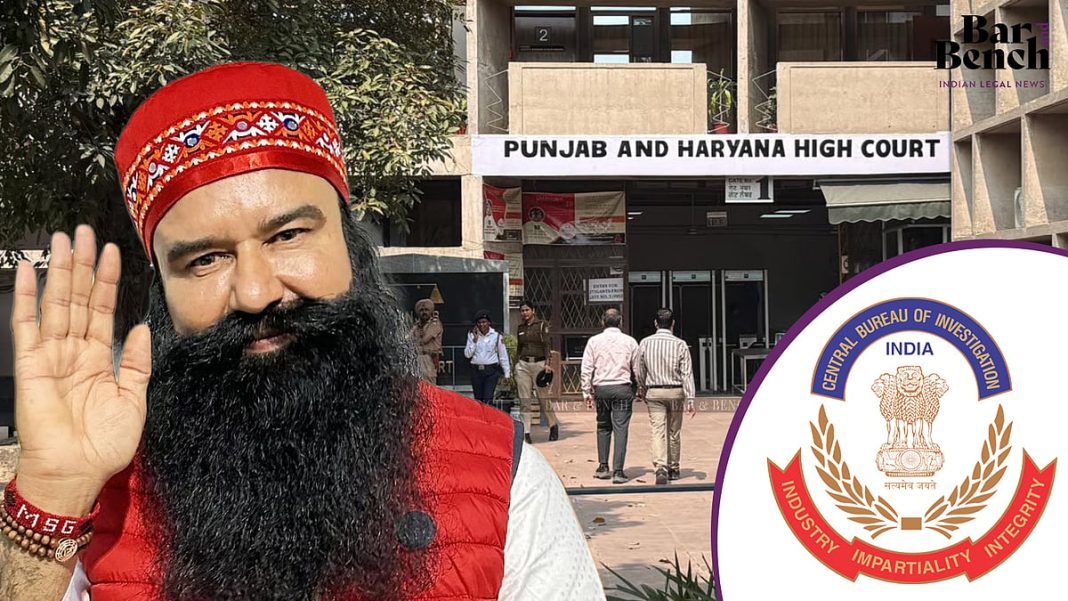
The legal landscape surrounding Gurmeet Ram Rahim Singh, the controversial head of Dera Sacha Sauda, has once again been shaken by significant judicial observations. In a development that raises pertinent questions about investigative integrity, the Punjab & Haryana High Court recently made striking remarks concerning the Central Bureau of Investigation’s (CBI) conduct in a murder probe involving Singh. The court’s observations suggest that the CBI might have coerced a witness to frame the Dera chief, reportedly under pressure to expedite the investigation.
High Court Scrutiny on Investigative Methods
The Punjab & Haryana High Court, while hearing a crucial matter related to the murder case of Ranjit Singh, a former Dera manager, cast a critical eye on the CBI’s investigative practices. This particular case saw Gurmeet Ram Rahim Singh convicted by a CBI special court in 2021. However, the High Court’s recent judgment, which subsequently acquitted Singh and four others in the Ranjit Singh murder case, delved deep into the investigative trail, uncovering what it deemed concerning lapses and questionable tactics.
Central to the court’s observations was the alleged coercion of a key witness. The High Court noted that the premier investigative agency, possibly operating under an explicit or implicit directive to conclude the probe swiftly, seemed to have compromised standard procedural norms. The judgment highlighted how such pressure could lead to shortcuts, potentially jeopardizing the fairness of an investigation and the rights of the accused. The court explicitly questioned the veracity of certain witness statements, implying they might have been extracted under duress rather than being voluntary affirmations of truth.
One of the pertinent observations by the High Court highlighted this concern, stating: “The Court cannot shut its eyes to the manner in which the investigation has been carried out by the CBI. It appears that under pressure from the High Court to conclude the probe, the agency coerced a witness into making statements to implicate Gurmeet Ram Rahim Singh.” This remark underscores the judiciary’s role as a watchdog, ensuring that even under judicial deadlines, the spirit of fair investigation is not compromised.
The Ranjit Singh Murder Case and its Wider Implications
The Ranjit Singh murder case dates back to 2002 when he was shot dead. Dera Sacha Sauda management suspected Ranjit Singh of being involved in circulating an anonymous letter alleging sexual exploitation of female followers by Gurmeet Ram Rahim Singh. His murder, along with that of journalist Ram Chander Chhatrapati, formed a part of the complex legal challenges faced by the Dera chief.
The High Court’s recent observations are not merely technical legal points; they carry significant weight for India’s criminal justice system. They raise profound questions about the independence and impartiality of investigative agencies, especially when handling high-profile cases. When a court points to potential coercion, it directly impacts public trust in institutions like the CBI, which are entrusted with upholding law and order without fear or favour.
For Gurmeet Ram Rahim Singh, who is already serving life imprisonment for the murder of journalist Ram Chander Chhatrapati and a 20-year sentence for the rape of two female disciples, this judgment provides a crucial legal reprieve in one of the murder cases. However, the broader implications extend to the methodology of investigations and the need for accountability within powerful agencies. It reiterates that judicial oversight is paramount to safeguard the principles of natural justice and prevent miscarriages of justice, irrespective of the notoriety of the individual involved.
Upholding Fair Trial Principles in India
The Punjab & Haryana High Court’s discerning remarks serve as a vital reminder of the foundational principles of a fair trial. In a country where the judiciary often acts as the final arbiter of justice, observations of this nature highlight the continuous need for rigorous checks and balances. They underscore the importance of distinguishing between legitimate investigative pressure and methods that might infringe upon a witness’s voluntariness or the accused’s right to a fair investigation.
This development will likely spur discussions on reforming investigative protocols and reinforcing ethical guidelines within law enforcement agencies. It calls for introspection into how external pressures, even those from the judiciary seeking timely completion, can inadvertently impact the quality and integrity of an investigation. Ultimately, the court’s stance reinforces the idea that justice must not only be done but must also manifestly and undoubtedly be seen to be done, adhering strictly to due process and fair play.
The ruling by the Punjab & Haryana High Court marks a significant chapter in the ongoing legal saga of Gurmeet Ram Rahim Singh. More importantly, it provides a critical judicial commentary on investigative practices, urging agencies like the CBI to maintain an unwavering commitment to impartiality and procedural integrity, even under duress, to ensure the sanctity of the justice delivery system in India.

