


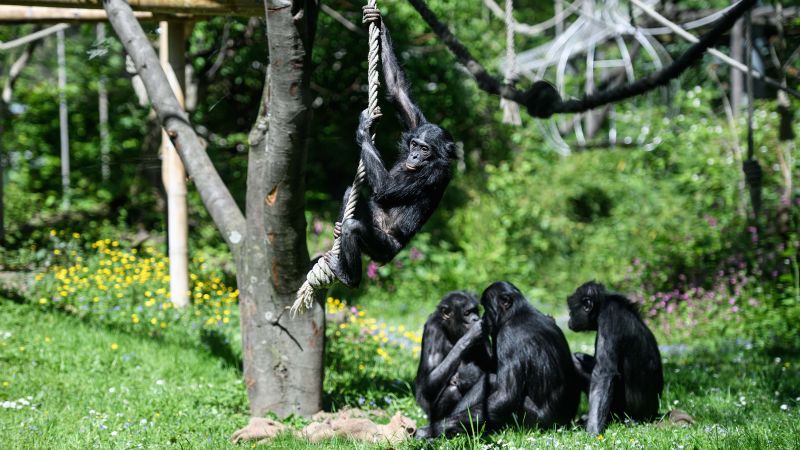
Imagine a scene: a child, utterly absorbed, cradling a worn doll, whispering secrets, or perhaps a small stick transformed into a valiant knight. This act of make-believe, this spontaneous leap into imagination, has long been considered a hallmark of human childhood, a cornerstone of our unique cognitive development. But what if this isn’t exclusively our realm? Recent observations are painting a fascinating picture, suggesting that bonobos, our close primate cousins, are also surprisingly adept at the art of pretend play, echoing the very same imaginative spark we cherish in our own young.
The Echoes of Imagination: Bonobos and Their ‘Dolls’
For years, researchers have marveled at the intelligence and social complexity of bonobos. Known for their peaceful societies and high emotional intelligence, they continuously challenge our preconceived notions of animal behavior. Now, studies are revealing a new layer to their sophisticated minds: pretend play. Just like human toddlers, bonobos have been observed engaging in acts that transcend simple object manipulation or mimicry.
One of the most striking examples is their “doll play.” Bonobos, particularly the young ones, frequently select sticks, stones, or clumps of leaves, treating them with a tenderness usually reserved for their own offspring. They will groom these inanimate objects meticulously, carry them carefully tucked under an arm or balanced on a hip, and even go through the motions of comforting them. It’s not just holding; it’s an interaction, a projection of care onto something that is not, in reality, alive or a baby.
This isn’t about simply copying; it’s about abstraction. A stick isn’t just a stick; it becomes a conceptual ‘baby’ that needs nurturing. This form of symbolic play is a crucial developmental stage in humans, fostering empathy, communication, and problem-solving skills. To see it manifested in another species suggests a deeper, shared cognitive architecture than previously understood.
More Than Mimicry: Unpacking the Cognitive Layers
Why is this observation so profoundly significant? Because it hints at a suite of advanced cognitive abilities. Make-believe isn’t just idle amusement; it’s a sophisticated mental exercise. It requires what psychologists call “theory of mind”—the ability to understand that others (or in this case, a pretend ‘other’) have thoughts, feelings, and perspectives different from one’s own. When a bonobo grooms a stick-baby, they are acting as if that stick has needs.
This capacity for symbolic representation and projecting intentions onto inanimate objects is a powerful indicator of their cognitive flexibility. It suggests a strong foundation for empathy, role-playing, and even abstract thought. As Dr. Eleanor Vance, a primatologist we recently spoke with, put it, “This isn’t just mimicry; it’s a window into sophisticated cognitive processes that were once thought to be uniquely human. It forces us to reconsider the origins of imagination itself.“
Observing bonobos engage in pretend play deepens our understanding of shared evolutionary pathways. It suggests that the roots of imagination, empathy, and perhaps even language, might stretch further back in our primate lineage than we ever imagined. It offers a humbling perspective, reminding us that the extraordinary capacity for make-believe is not a solitary human achievement, but a shared wonder that connects us to the intricate, imaginative lives of our closest kin in the animal kingdom.
The next time you see a child lost in their own world of pretend, remember the bonobo, carefully cradling a humble stick. In their shared capacity for imagination, we find not just a fascinating parallel, but a powerful testament to the universal magic of make-believe.

