


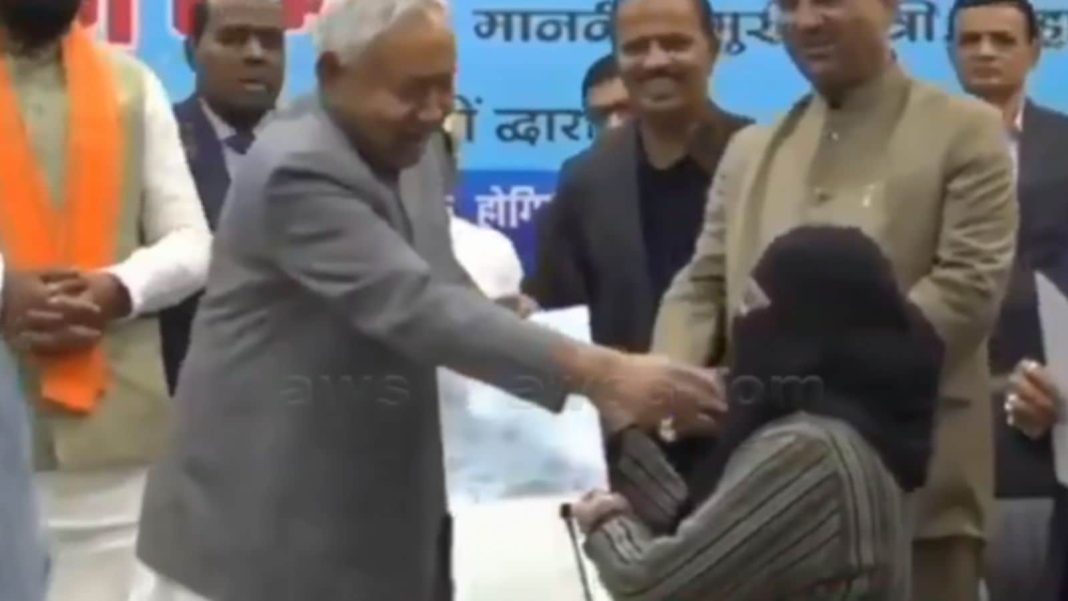
A recent development in Bihar has reignited public discourse surrounding a controversial incident involving Chief Minister Nitish Kumar. Dr. Farzana Siddiqui, the medical professional whose hijab was reportedly pulled down by the CM during an inspection earlier this year, has failed to join her new posting at a district hospital, raising questions and prompting varied reactions across the state.
The Precedent: An Incident That Sparked Outrage
The original incident, which occurred approximately three months ago, sent ripples across national media and social circles. Chief Minister Nitish Kumar was conducting a surprise inspection at a primary healthcare centre in the Samastipur district when the controversial interaction with Dr. Siddiqui took place. According to eyewitnesses and subsequent media reports, during an exchange over hospital protocols or patient care, the Chief Minister reportedly reached out and pulled down Dr. Siddiqui’s hijab.
The action was widely condemned by various segments of society, particularly women’s rights organizations and minority groups, who viewed it as an egregious violation of personal space and religious freedom. While the Chief Minister’s office had not issued a direct apology or clarification, some political observers suggested it was an impulsive reaction during a stressful inspection, rather than an intentional act of disrespect. However, the damage to public perception was significant, especially in a state with a substantial Muslim population and a history of inter-community sensitivities. Dr. Siddiqui, a respected medical officer, had remained largely silent on the issue in the immediate aftermath, reportedly expressing distress privately.
Dr. Siddiqui’s Absence: Unanswered Questions
Dr. Farzana Siddiqui was recently transferred from her previous posting and mandated to join duty at a district hospital in Begusarai. However, despite the official orders, she has not reported for work. Sources within the Bihar Health Department confirm that the stipulated joining period has lapsed, and no official communication detailing her reasons for absence has been received by the department.
This development has fueled speculation. Some close to Dr. Siddiqui suggest that the trauma from the initial incident, combined with the subsequent public scrutiny, has made it difficult for her to return to public-facing duty. There are whispers of mental health concerns and a desire for a more private role, away from the glare of potential political or media attention. Others speculate about possible pressure or an underlying protest against the perceived lack of accountability for the Chief Minister’s actions. The Health Department, while acknowledging her absence, has refrained from making any definitive statements, citing privacy concerns and standard administrative procedures for non-joining employees.
“This incident highlights the delicate balance between administrative authority and individual rights, especially in a diverse society like ours,” observed Dr. Priya Sharma, a Patna-based social commentator. “The state has a responsibility to ensure a safe and respectful working environment for all its public servants, free from any form of intimidation or humiliation.”
Implications for Governance and Public Service
Dr. Siddiqui’s failure to join duty underscores deeper issues concerning governance, professional autonomy, and the protection of individual dignity in public service. For a state government that often champions schemes for women’s empowerment and inclusive development, this episode presents an uncomfortable challenge. It raises questions about how incidents involving high-profile political figures and common citizens are handled, and whether sufficient mechanisms are in place to address grievances and ensure justice.
The silence from Dr. Siddiqui and the lack of a clear official explanation for her absence leave a void that is quickly filled by public interpretation. It could be seen as a personal tragedy for a dedicated doctor, or as a symbol of the broader challenges faced by professionals navigating a system where power dynamics can sometimes override personal boundaries. Regardless of the underlying reasons, the episode serves as a stark reminder of the lasting impact of such incidents and the critical importance of respectful conduct in all spheres of public life, particularly from those in positions of power.
As the Bihar Health Department reviews Dr. Siddiqui’s case, the wider public remains attentive, hoping for a resolution that respects both professional obligations and individual dignity, and perhaps, a clearer path forward for those caught in the crossfire of public life.

