


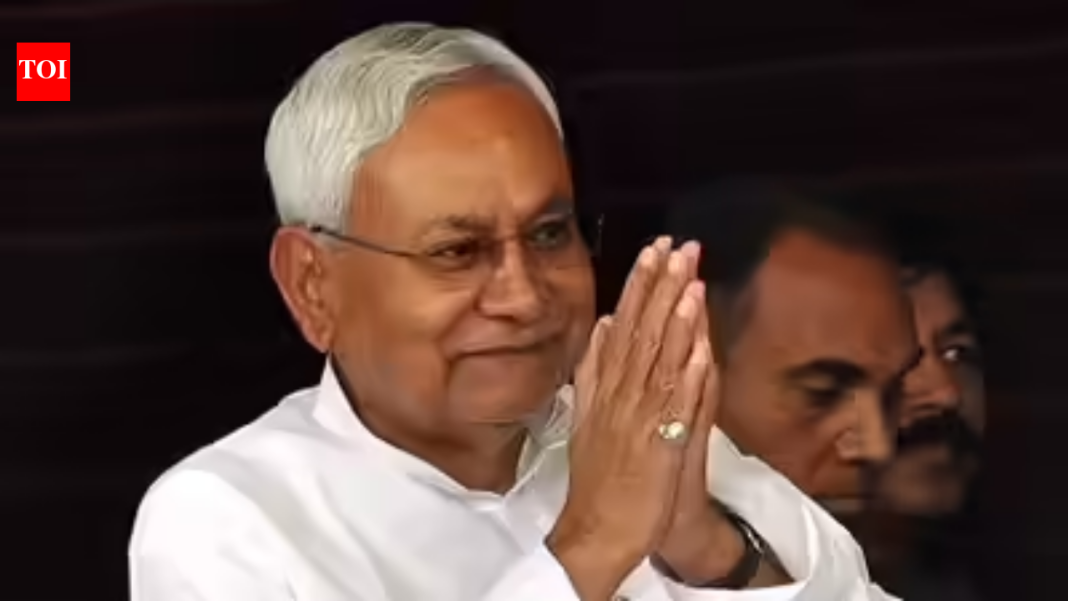
The political landscape in Bihar, long a crucible of intricate alliances and seasoned leadership, is once again abuzz with significant speculation. Reports emerging from Janata Dal (United) sources suggest a potential major shift for Bihar’s veteran Chief Minister, Nitish Kumar. If these sources are to be believed, Kumar, a political figure known for his strategic acumen and numerous shifts across the political spectrum, is contemplating a move to the Rajya Sabha, the upper house of India’s Parliament.
This development, while not officially confirmed by the JDU leadership or Kumar himself, has ignited a flurry of discussions across national and state political circles. It signals not just a potential change in Bihar’s leadership dynamics but also hints at broader implications for the ruling National Democratic Alliance (NDA) and the forthcoming political alignments in the run-up to future elections.
The Buzz in Political Corridors
Unpacking the JDU Sources’ Claims
The murmurs gained traction through various media reports citing unnamed JDU insiders. These sources indicate that the idea of Nitish Kumar transitioning to the Rajya Sabha has been deliberated within the party for some time. Such a move would allow him to step back from the direct day-to-day electoral pressures of state assembly politics while continuing to play a crucial role in national legislative discourse. The timing of these leaks is also noteworthy, coming at a juncture where the NDA government in Bihar, comprising JDU and BJP, seems stable, yet underlying power equations are constantly evolving.
Potential Motivations for a Shift
Several theories are circulating regarding the potential motivations behind such a significant political maneuver. One prominent perspective suggests it could be a strategic play to elevate Kumar to a more prominent national role, leveraging his extensive administrative experience and reputation as a governance-focused leader. Another theory posits it as a gradual succession planning exercise within Bihar, potentially paving the way for a new Chief Minister, though the identity of such a successor remains a topic of intense speculation. It could also be seen as an attempt to insulate Kumar from potential anti-incumbency sentiments that often accumulate after multiple terms as Chief Minister, positioning him for a different kind of influence.
A Veteran’s Enduring Political Saga
Decades of Strategic Shifts
Nitish Kumar’s political journey has been marked by remarkable resilience and strategic flexibility. Known colloquially by some as ‘Sushasan Babu’ (good governance man) for his emphasis on development and law and order during his various tenures as Chief Minister, he has also earned a reputation for his willingness to switch alliances, often referred to by critics as ‘Paltu Ram’ (turncoat). From his early days as an engineer turned socialist leader to becoming a key architect of Bihar’s development, Kumar has navigated complex political currents with unparalleled adroitness. His leadership has seen Bihar achieve significant milestones in infrastructure and social welfare, solidifying his image as a leader who delivers.
The National Ambition Angle
A move to the Rajya Sabha could resurrect long-standing speculations about Kumar’s national ambitions. Having served as a Union Minister in previous NDA governments, he possesses an understanding of national policy and administration. While his past attempts to project himself as a national alternative or a unifier of opposition forces met with limited success, a stint in the Rajya Sabha could offer a renewed platform. It could allow him to engage with national issues more directly, contribute to legislative debates, and potentially even assume a senior role within the NDA’s national framework, should the opportunity arise.
Reflecting on this, Dr. Rakesh Singh, a seasoned political observer based in Patna, noted, “Nitish Kumar’s move to the Rajya Sabha, if it materializes, would be more than just a change of seat. It signifies a strategic re-evaluation of his political role. For a leader of his stature, the Upper House offers a different kind of gravitas and influence, allowing him to shape national discourse without the immediate pressures of state-level electoral politics.”
Implications for Bihar and Beyond
The Bihar Leadership Conundrum
Perhaps the most immediate and impactful consequence of Kumar’s potential move would be the leadership vacuum in Bihar. The question of who would succeed him as Chief Minister is paramount. While the JDU would naturally prefer a leader from its own ranks, the BJP, being a dominant partner in the NDA, might also eye the top post. This could trigger intense negotiations and power struggles within the coalition, potentially leading to unforeseen political realignments in a state crucial for national electoral outcomes.
A New Chapter in National Politics?
For the NDA at the national level, Nitish Kumar in the Rajya Sabha could be a double-edged sword. On one hand, his vast experience and reputation could strengthen the government’s legislative efforts and bring a respected voice to national debates. On the other, his history of political independence and occasional dissent could also introduce new dynamics within the ruling alliance. His presence could add a layer of complexity or, conversely, a valuable dimension of consensus-building, depending on the political exigencies of the time. The 2024 Lok Sabha elections are around the corner, and every move by a senior leader like Nitish Kumar will be scrutinized for its potential impact on the broader political narrative.
As the political rumour mill churns, the focus remains on Patna and New Delhi for any official confirmation or denial. Nitish Kumar’s potential shift to the Rajya Sabha underscores the continuous fluidity and strategic calculations inherent in Indian politics, promising to open a new chapter not just for him, but for the political future of Bihar and potentially the national landscape.

