


The universe often sends us celestial riddles, and few are as intriguing as 3I/ATLAS, an interstellar visitor that recently swung perilously close to our Sun. As it emerged from its fiery encounter, the scientific community held its breath, eager to decode the changes etched onto its surface – or, more accurately, its light signature. Leading the charge in this fascinating post-perihelion analysis is none other than Professor Avi Loeb, a name synonymous with pushing the boundaries of astrophysical inquiry. His focus on the subtle dance of light reflected and emitted by 3I/ATLAS promises to reveal far more than just surface-level truths about this enigmatic object.
The Comet That Wasn’t Quite: 3I/ATLAS’s Sun-Kissed Revelation
3I/ATLAS first captured our attention not just because it’s an interstellar interloper, but because of its perplexing behavior. Initially dubbed a comet due to its developing coma and tail, subsequent observations suggested something more complex. Unlike typical comets which brighten predictably as they approach the Sun, 3I/ATLAS exhibited an unusual fragmentation and dimming event during its solar flyby. This close encounter, where it dove within the Sun’s blistering corona, was a crucible. The intense heat, radiation, and gravitational stresses would have profoundly impacted any object, natural or otherwise.
The core question isn’t just about whether it survived intact, but how it changed. Did the Sun strip away layers of ice, revealing a solid core? Did it shatter into countless fragments, or perhaps, did its unique composition react in unexpected ways? For Loeb and his team, the light returning from 3I/ATLAS after its solar pass isn’t just a signal; it’s a historical record, a cosmic diary detailing the object’s resilience and makeup. Any anomaly in its post-flyby luminosity or spectral signature could provide crucial clues about its true nature – clues that were impossible to gather from its initial distant observations.
Avi Loeb’s Lens: Peering into the Afterglow
Professor Avi Loeb, known for his bold interpretations of interstellar objects like Oumuamua, brings a distinct perspective to the analysis of 3I/ATLAS. Rather than merely cataloging its destruction or survival, Loeb is deeply interested in what its light can tell us about its fundamental properties, especially in the context of extreme solar heating. He’s not just looking for a comet; he’s looking for anything that deviates from our current understanding of natural celestial bodies under such conditions.
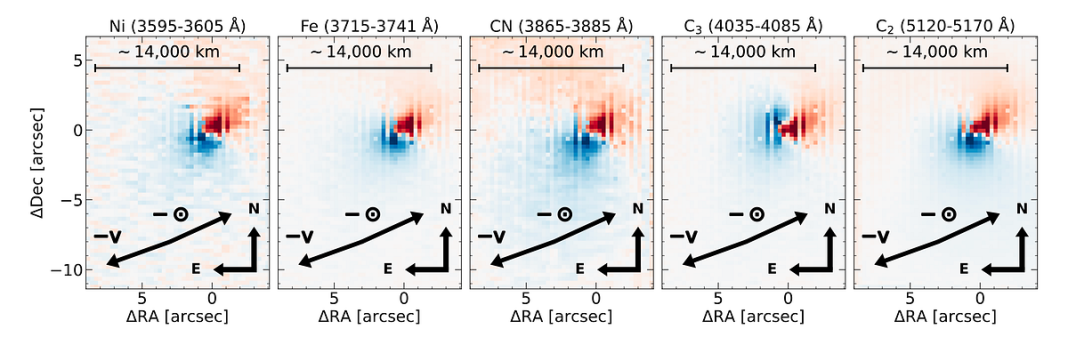
The post-solar light analysis involves meticulous examination of its brightness curve – how it dims and brightens over time – and its spectral data, which breaks down the light into its constituent colors, revealing chemical compositions and physical states. Are there unexpected elements present? Does its light pattern suggest a stable, metallic core, or perhaps a more porous, volatile structure? “Loeb’s approach reminds us that while statistics guide much of astronomy, true breakthroughs often come from scrutinizing the outliers, especially when dealing with such rare interstellar visitors,” notes Dr. Anya Sharma, a theoretical physicist following the research. This is where the hunt for the extraordinary truly begins. If 3I/ATLAS shows light characteristics that defy our conventional models of comet or asteroid destruction, it could open up a whole new realm of possibilities about what journeys through the interstellar void.
The stakes are high. Every photon returning from 3I/ATLAS carries a fragment of its story. Loeb and his collaborators are sifting through this cosmic dust, not just to confirm what we already know, but to challenge it. The analysis of this interstellar wanderer, post-solar swing, could redefine our understanding of extrasolar objects, pushing us to consider whether our cosmic neighborhood might be home to more surprises than we currently imagine.
As the data continues to flow in and is rigorously examined, the universe holds its breath, waiting for the full story of 3I/ATLAS to unfold. Whatever the findings, Loeb’s persistent inquiry ensures that no stone, or indeed, no beam of light, is left unturned in our quest to understand the vast unknown.

