


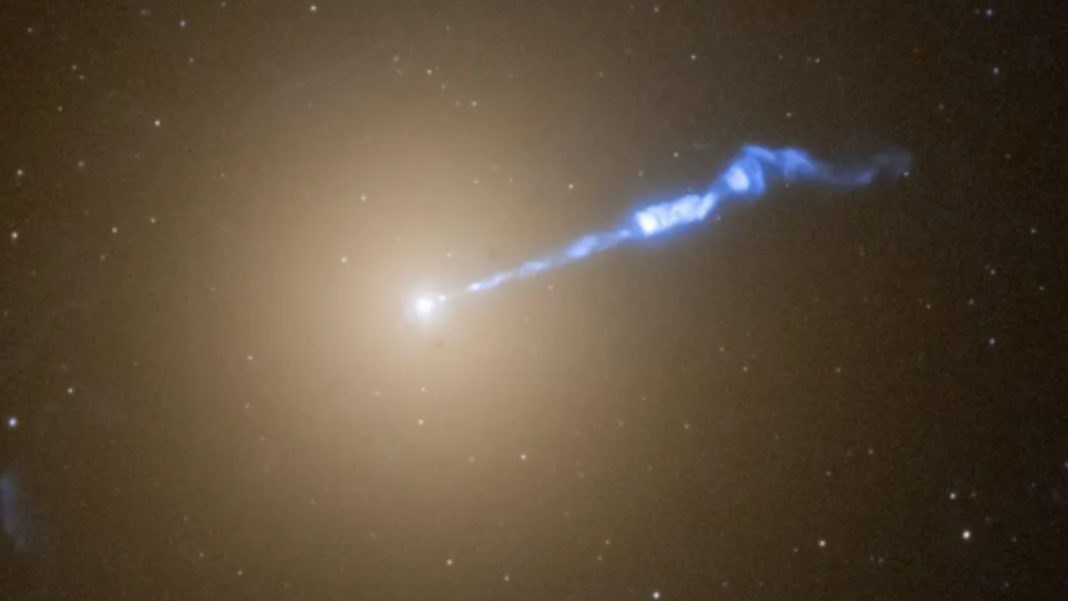
The universe, in its infinite wisdom and wonder, continues to unveil its deepest secrets, one mind-bending observation at a time. Remember that iconic image, the orange-red ring of light encircling the dark abyss of M87*’s supermassive black hole? It was a monumental achievement, giving us the first direct glimpse of such a cosmic titan. Now, astronomers have outdone themselves, watching this very same black hole launch an astonishing 3,000-light-year-long cosmic jet from its glowing “shadow.” It’s a profound moment that takes our understanding of these enigmatic objects to a thrilling new dimension.
The Heart of Darkness Roars to Life
For years, M87* has been a star, or rather, an anti-star, in the astronomical community. Its immense gravity warps space and time, pulling in gas and dust, forming a superheated accretion disk that glows fiercely before the point of no return. The “shadow” we first saw was the silhouette of the event horizon against this brilliant backdrop. But black holes aren’t just cosmic vacuum cleaners; they are also powerful engines capable of astounding feats.
The new observations reveal M87* is more dynamic than ever imagined. While we knew black holes could produce jets, seeing one erupt from the very region we previously imaged its event horizon is like finally understanding the mechanics behind a magic trick. This isn’t just a faint wisp; it’s a colossal stream of high-energy particles, accelerated to near the speed of light, extending thousands of light-years into space. It’s a direct observation of the black hole actively shaping its galactic environment, a cosmic lighthouse piercing through the dark.
Decoding the Cosmic Engine Room
How does a black hole, an object famous for swallowing everything, manage to launch such an enormous and energetic jet? The leading theories point to a potent combination of a rapidly spinning black hole and powerful magnetic fields. As matter spirals into the black hole, these magnetic fields become incredibly twisted and amplified. They act like a slingshot, capturing some of the infalling particles and flinging them outwards at incredible speeds, channeling them into a narrow, focused beam. This newly observed jet from M87* provides invaluable data, allowing researchers to test and refine these complex astrophysical models. It’s a direct window into the extreme physics governing the universe’s most powerful engines.
The sheer scale of this phenomenon is difficult to grasp. Three thousand light-years is an unimaginably vast distance, extending far beyond the confines of M87‘s immediate vicinity. It means the jet is influencing gas and star formation across an enormous swathe of the galaxy. “Seeing this colossal jet erupt from the very heart of M87, precisely where we first glimpsed its shadow, is like watching the universe’s most powerful engine kick into overdrive,” marvels Dr. Lena Petrova, a research astronomer who has studied active galactic nuclei for decades. “It’s not just a snapshot; it’s a dynamic story unfolding, showing us how black holes aren’t passive objects but active architects of galactic evolution.”
A New Perspective on Cosmic Power
This remarkable observation isn’t just a triumph for the Event Horizon Telescope collaboration; it’s a leap forward for astrophysics itself. It connects the dots between the extreme environment right at the edge of a black hole and the large-scale structures we observe in galaxies. It offers a tangible link between theoretical predictions and empirical evidence, pushing the boundaries of what we understand about gravity, magnetism, and matter under the most extreme conditions imaginable.
As we continue to observe these cosmic titans with ever-improving technology, each new piece of the puzzle brings us closer to a complete picture of our universe. The black hole at the center of M87* isn’t just a static image anymore; it’s a vibrant, powerful entity actively shaping the cosmos around it. And with every new discovery, humanity’s journey into the unknown continues to illuminate the incredible majesty and complexity that surrounds us.

