


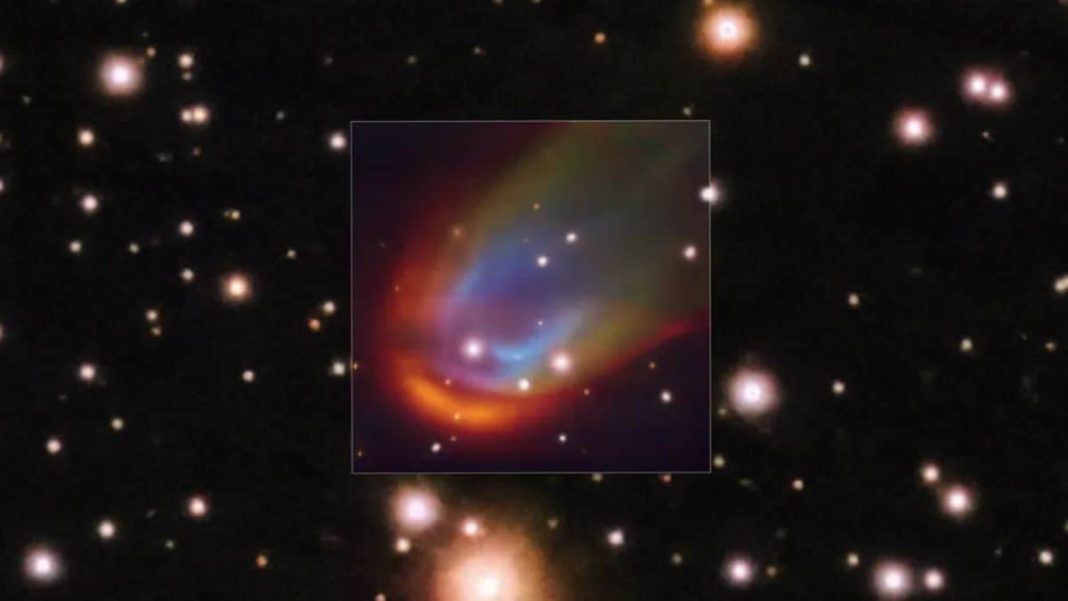
The cosmos continues to be a canvas of endless mysteries, constantly challenging our understanding of its fundamental laws. Just when scientists believe they have deciphered a celestial process, the universe unfurls a new enigma. Such is the case with a groundbreaking discovery surrounding the planetary nebula NGC 7027, often dubbed the “Jewel Bug Nebula.” Astronomers, utilising advanced observational tools, have stumbled upon an unprecedented phenomenon: a powerful, unexpected magnetic “engine” powering this massive nebula, seemingly defying the established physics of dead stars. This finding not only redefines our perception of stellar death but also opens new frontiers in astrophysical research, echoing India’s own burgeoning interest in deep space exploration and cosmology.
Unveiling NGC 7027: A Cosmic Anomaly
NGC 7027 is a spectacular planetary nebula located approximately 3,000 light-years away in the constellation Cygnus. Planetary nebulae are often beautiful, glowing shells of gas and dust ejected by dying stars as they transition from red giants into white dwarfs – their final, dense, and relatively inactive stages. For decades, NGC 7027 has fascinated astronomers due to its unusually young age for a planetary nebula and its complex, multi-lobed structure, suggesting a dynamic and violent past.
Recent observations, particularly those involving the Atacama Large Millimeter/submillimeter Array (ALMA) in Chile, have provided an unprecedented look into the nebula’s core. What scientists expected to find was a relatively quiescent white dwarf, slowly cooling down. Instead, they discovered evidence of an incredibly strong and highly ordered magnetic field emanating directly from the dying star. This magnetic field is not only powerful enough to shape the vast nebula but also appears to be driven by an internal mechanism that astronomers are calling a “mystery engine.”
The “Mystery Engine” and Challenging Stellar Physics
The conventional understanding dictates that as a star like our Sun exhausts its nuclear fuel and sheds its outer layers to form a planetary nebula, its core collapses into a white dwarf. This white dwarf is a compact, hot remnant, but it’s generally considered to be largely inert, incapable of generating the kind of powerful, collimated jets and strong magnetic fields observed in NGC 7027. Such energetic phenomena are typically associated with much younger, more active stars or binary systems where two stars interact, often involving accretion disks that funnel material onto a companion, generating magnetic fields and powerful outflows.
The “mystery engine” around the solitary white dwarf in NGC 7027 challenges this framework directly. The observed magnetic fields are shaping the nebula, indicating an ongoing process of energy generation and channeling. This suggests that the dying star is far from inert, somehow generating and sustaining these powerful magnetic fields. “This discovery forces us to reconsider the fundamental processes governing the final stages of stellar evolution,” states Dr. Elena Petrova, lead astronomer on the research team. “The magnetic fields we’re seeing are exceptionally strong and well-organised, implying a mechanism we simply don’t have a complete theoretical explanation for in a single, dead star. It’s truly baffling and exhilarating at the same time.”
One leading hypothesis is that the star might have recently undergone a very brief, intense phase of rapid rotation or interaction with unseen planetary material, which could have amplified its magnetic field. However, evidence for such interaction is scarce, and the sheer power observed points to something more intrinsic or sustained. Another possibility involves complex dynamics within the white dwarf itself, perhaps related to its internal structure or the last throes of its gravitational collapse, creating a dynamo effect. Whatever the explanation, it demands a significant re-evaluation of current astrophysical models.
Implications for Stellar Evolution and Future Research
This discovery has profound implications for our understanding of stellar evolution, particularly the fate of stars similar to our Sun. If single white dwarfs can indeed harbour such “mystery engines,” it suggests that the violent, energetic phenomena previously attributed only to binary systems or highly active young stars might be more common than imagined in the stellar graveyard. It could mean that many more planetary nebulae are shaped by these invisible magnetic forces, waiting to be detected by instruments like ALMA, which offer unprecedented resolution and sensitivity to detect molecular gas and magnetic fields.
For India, a nation increasingly making its mark in space science with missions like Chandrayaan and Aditya-L1, such global discoveries serve as a powerful inspiration. Understanding these cosmic engines is crucial not only for theoretical physics but also for advancing technologies that can observe and interpret these distant phenomena. Indian astronomers and physicists are keenly following these developments, contributing to global collaborations and pushing the boundaries of knowledge. The challenge posed by NGC 7027 highlights that even the most well-studied objects in the universe can hold secrets capable of rewriting textbooks.
The “mystery engine” in NGC 7027 is a potent reminder of how much we still have to learn about the universe. It encourages us to continue peering deeper into the cosmos, equipped with ever more sophisticated tools and an open mind, ready to embrace discoveries that challenge our most cherished theories. As science progresses, it’s often these anomalies that pave the way for revolutionary insights, promising an even richer understanding of the grand tapestry of space and time.
*

