


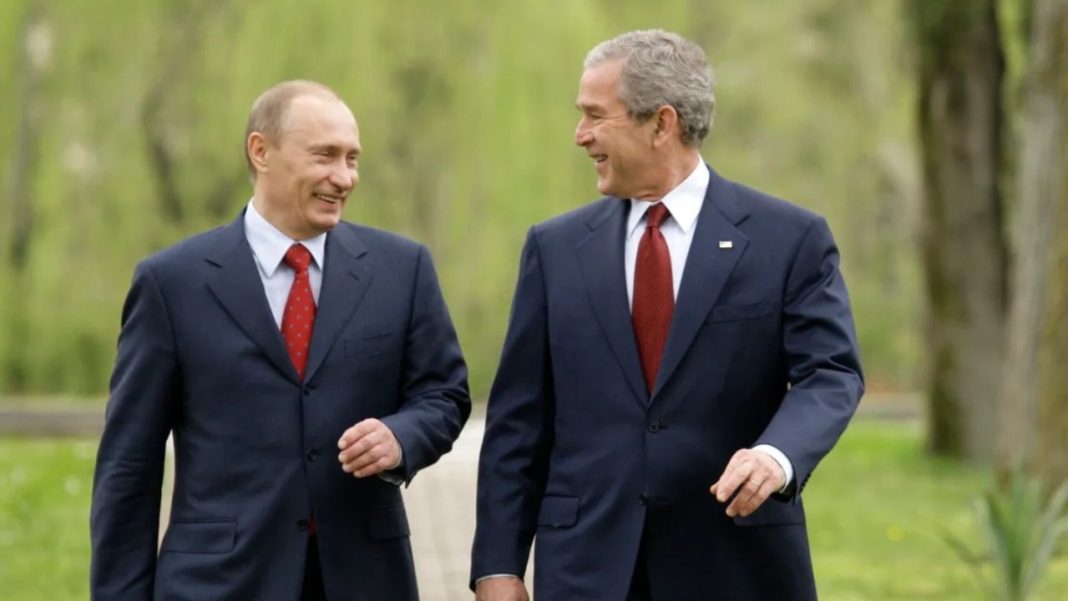
The current geopolitical landscape, particularly the conflict in Ukraine, often appears to be a sudden eruption. Yet, history frequently reveals that seemingly abrupt events are often the culmination of long-simmering tensions and deeply held beliefs. Years before the full-scale invasion of 2022, a critical conversation between Russian President Vladimir Putin and then-US President George W. Bush offered a chilling premonition of Moscow’s enduring perspective on Ukraine’s sovereignty. This exchange, largely overlooked at the time, now stands as a stark indicator of the ideological foundations underpinning Russia’s actions and provides crucial context for understanding the conflict’s roots.
The Echoes of a Seminal Conversation
The year was 2008, a period of escalating tensions and pivotal decisions regarding NATO expansion, particularly concerning Ukraine and Georgia. Amidst these discussions, President Putin reportedly conveyed a clear and profoundly unsettling message to President Bush regarding Ukraine’s very existence. Accounts from those present, including Bush himself in his memoirs, recall Putin stating that Ukraine was not a real country, but rather an “artificial state” created from historical Russian lands. This was not merely an offhand diplomatic remark but a deeply ingrained historical narrative that has demonstrably shaped Russian foreign policy for decades.
For Putin, Ukraine was intrinsically linked to Russia, its sovereignty a modern construct born out of the Soviet Union’s collapse, rather than an organic, centuries-old nation-state. This perspective fundamentally clashes with Ukraine’s own national identity, its historical trajectory, and its internationally recognised status as a sovereign nation. The exchange highlighted a profound divergence in how the two leaders, and their respective nations, perceived the post-Soviet geopolitical order and the legitimate aspirations of newly independent states.
Historical Narratives and Geopolitical Fissures
Putin’s assertion that Ukraine is an “artificial state” is rooted in a specific interpretation of history, one that emphasizes the shared medieval Kyivan Rus’ heritage and the long periods of Russian imperial rule over much of modern Ukraine. From this vantage point, the idea of a separate Ukrainian identity is often portrayed as a historical aberration, cultivated by external powers or recent political movements rather than a genuine expression of national self-determination. The dissolution of the Soviet Union in 1991, which saw Ukraine declare independence, was viewed by many in Moscow as a catastrophic geopolitical defeat, and the subsequent westward alignment of former Soviet republics, including Ukraine, as an existential threat to Russia’s security and sphere of influence.
This historical lens, emphasizing cultural and historical kinship over contemporary sovereign borders, provided the ideological bedrock for future Russian actions. It helps explain the annexation of Crimea in 2014 and the full-scale invasion in 2022, which Moscow presented not as an invasion of a sovereign state but as a historical reclamation and a response to perceived Western encroachment. Understanding this deep-seated belief is crucial for grasping the motivations behind Moscow’s aggressive posture towards its neighbour and the profound challenge it poses to the established international order.
“You have to understand, George, that Ukraine is not even a state.” This direct quote, attributed to Vladimir Putin by George W. Bush in his memoir, Decision Points, succinctly captures the essence of Putin’s long-held conviction. It underscores the profound difference in perception between Moscow and much of the international community regarding Ukraine’s legitimate existence as a sovereign nation.
India’s Balanced Stance in a Fragmented World
For a global actor like India, navigating such complex historical narratives and their contemporary geopolitical fallout presents a unique and delicate challenge. India has consistently advocated for the sovereignty and territorial integrity of all nations, a principle central to its foreign policy and enshrined in its own historical experience as a post-colonial state. However, its long-standing strategic partnership with Russia, particularly in defence and energy, necessitates a nuanced and pragmatic approach. While New Delhi has repeatedly urged for a peaceful resolution and respected international law, it has also refrained from overtly condemning Russia, understanding the multifaceted historical and security concerns at play.
The concept of an “artificial state” holds particular intellectual intrigue from an Indian perspective, given India’s own diverse history and the careful management of numerous linguistic, cultural, and regional identities within its robust federal structure. India’s emphasis remains firmly on dialogue, de-escalation, and upholding a rules-based international order, even as it acknowledges the varied historical interpretations that often fuel modern conflicts. This pragmatic stance reflects India’s commitment to strategic autonomy and its ability to engage with all parties in a multipolar world, seeking to foster stability amidst global turbulence.
Conclusion
Vladimir Putin’s 2008 remarks to George W. Bush were not merely a diplomatic aside but a profound articulation of a worldview that would eventually come to redefine European security. The persistent belief that Ukraine is an “artificial state” has served as a powerful historical justification for Russia’s actions, culminating in the tragic and devastating conflict we witness today. For global actors like India, understanding the deep historical and ideological currents driving such conflicts is paramount. While upholding principles of sovereignty and international law, nations must also grapple with the complex narratives that shape geopolitical realities, constantly seeking pathways for peace and stability in an increasingly interconnected and often contested world. The echoes of that 2008 conversation continue to reverberate, serving as a powerful reminder that sometimes, the most significant warnings are spoken long before the storm truly breaks.

