


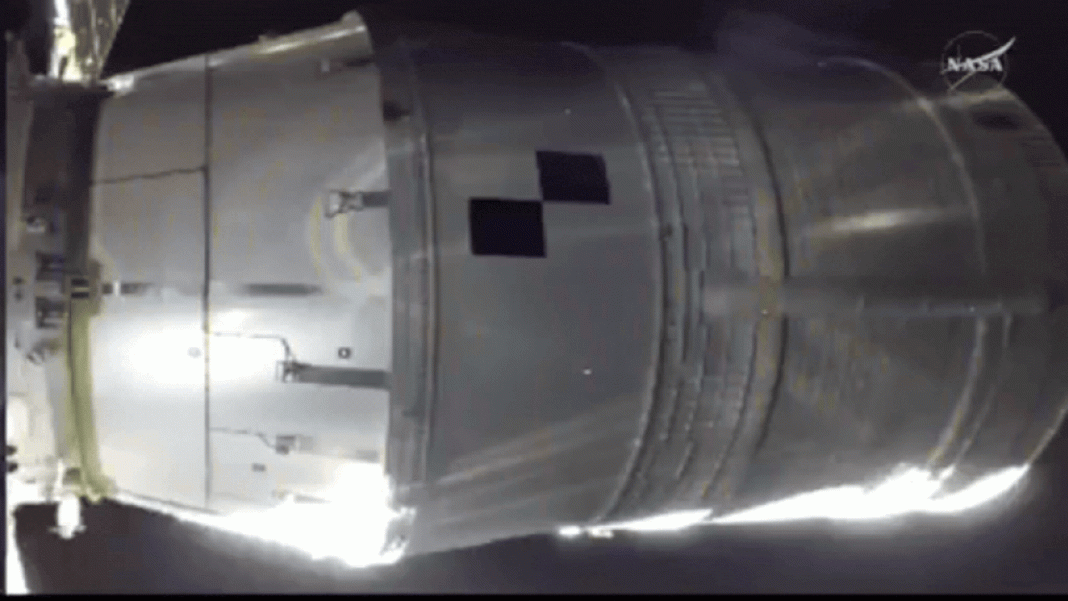
In an era increasingly defined by sophisticated automation, the human element in space exploration remains undeniably crucial. NASA’s ambitious Artemis program, aiming to return humanity to the Moon, recently underscored this by releasing a video showcasing the Artemis II astronauts practicing manual piloting of the Orion spacecraft. This pivotal demonstration, captured during a simulation, serves as a powerful reminder that while technology propels us forward, the skill, judgment, and adaptability of human astronauts are irreplaceable, especially on missions to the deep reaches of space.
The Human Touch in Deep Space: Orion’s Manual Piloting Demo
The recently unveiled NASA video offers a captivating glimpse into the rigorous training undertaken by the Artemis II crew – Commander Reid Wiseman, Pilot Victor Glover, Mission Specialist Christina Koch, and Canadian Space Agency (CSA) astronaut Jeremy Hansen. It highlights their proficiency in manually controlling the Orion spacecraft, a task that goes beyond merely monitoring automated systems. The simulation involved practicing critical maneuvers, including attitude control, aiming the spacecraft’s heat shield, and maintaining precise trajectories for potential rendezvous operations.
Why is manual piloting so critical in the 21st century? While Orion boasts advanced autonomous capabilities, human intervention provides an indispensable layer of safety and flexibility. In the unforgiving vacuum of space, unforeseen anomalies, system glitches, or tactical adjustments might necessitate a rapid, intuitive response that only a trained human pilot can provide. This capability ensures that the crew can adapt to dynamic situations, make on-the-spot decisions, and maintain control even if primary automated systems encounter issues. It’s about mastering the spacecraft as an extension of their will, rather than being mere passengers.
As Artemis II Pilot Victor Glover succinctly put it, reflecting the mindset of these elite spacefarers: “We are pilots, and we are going to fly.” This sentiment encapsulates the essence of the training and the continued importance of human agency in complex space missions.
Artemis II: A Crucial Stepping Stone Back to the Moon
The Artemis II mission is far more than just a test flight; it’s a monumental step in humanity’s return to lunar exploration after more than half a century. Slated as the first crewed mission of NASA’s Artemis program, it will send the four astronauts on a challenging journey around the Moon and back, validating critical systems and procedures before the subsequent Artemis III mission attempts a lunar landing. The manual piloting practice is integral to this validation process, ensuring the crew can operate Orion effectively under all circumstances.
The mission objectives for Artemis II are comprehensive: testing Orion’s life support systems, communications, navigation, and propulsion in a deep-space environment with humans onboard. The crew will be living and working farther from Earth than any human has gone before, pushing the boundaries of human endurance and technological capability. The ability to manually guide Orion through portions of this unprecedented journey adds a crucial layer of confidence and redundancy to the mission’s overall safety and success profile, preparing not just for Artemis III but for sustained lunar presence.
India’s Lunar Ambitions Align with Global Space Endeavors
For India, a nation rapidly advancing its own space capabilities, NASA’s Artemis II endeavors resonate deeply. ISRO’s successful Chandrayaan missions, including the recent soft landing of Chandrayaan-3 on the lunar south pole, have firmly established India as a significant player in lunar exploration. While ISRO’s immediate focus remains on unmanned lunar science and the forthcoming Gaganyaan human spaceflight program, the lessons and developments from missions like Artemis II offer valuable insights.
The emphasis on human skill and manual control demonstrated by the Artemis II crew serves as a compelling benchmark for future Indian deep-space ambitions. As ISRO envisions more complex missions, including potential crewed lunar missions in the distant future, the rigorous training protocols and the importance of astronaut adaptability showcased by NASA will undoubtedly inform India’s own strategic planning. The global push back to the Moon, with nations like India at the forefront, signifies a collaborative spirit in unlocking the secrets of our celestial neighbour and expanding humanity’s footprint beyond Earth.
The NASA video of Artemis II astronauts manually piloting Orion is more than just a training update; it’s a powerful statement about the enduring value of human ingenuity and skill in the grand pursuit of space exploration. As we stand on the cusp of a new era of lunar discovery, the blend of cutting-edge technology and unparalleled human capability promises to pave the way for humanity’s sustained presence on the Moon and beyond.

