


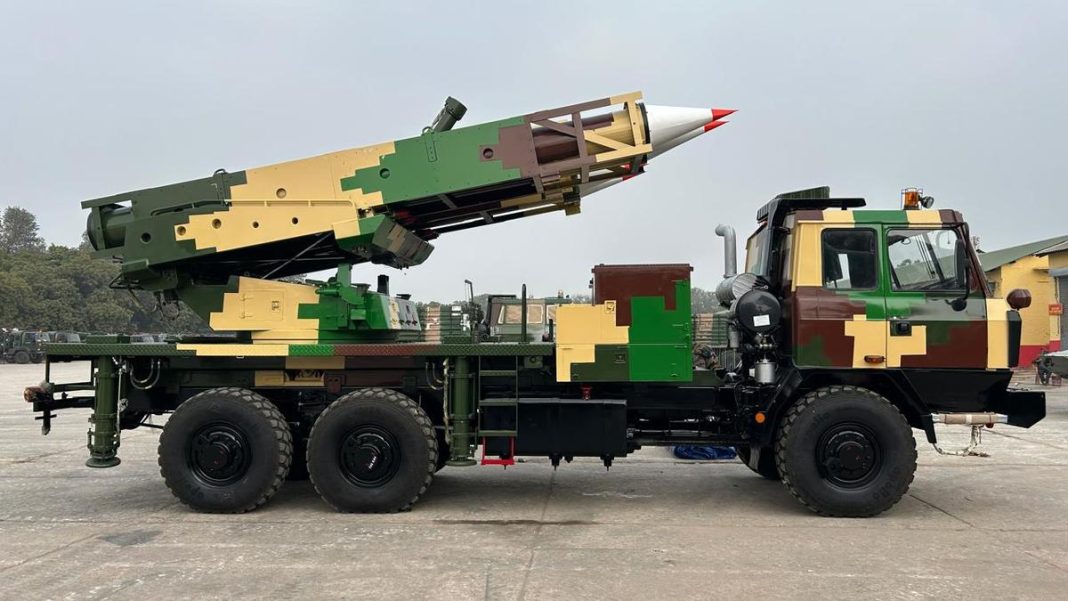
The Indian Army has taken a significant leap forward in modernizing its artillery capabilities by formalizing a procurement deal for the long-range rocket launcher system, Suryastra. This landmark agreement marks a pivotal moment for India’s defense sector, not only bolstering its operational readiness but also underscoring the nation’s unwavering commitment to indigenous defense manufacturing under the ‘Make in India’ initiative. The induction of Suryastra is set to provide the Army with an advanced, potent, and highly accurate long-range strike capability, enhancing India’s deterrence posture on its borders.
The Suryastra System: A New Era in Artillery
The Suryastra system, a name signifying the ‘Sun Weapon’, represents a sophisticated leap in India’s conventional firepower. Designed and developed domestically, this state-of-the-art multi-barrel rocket launcher (MBRL) system is engineered to deliver precision strikes at extended ranges, significantly beyond the capabilities of many existing artillery platforms. Key features of the Suryastra include its advanced navigation and guidance systems, allowing for exceptional accuracy even against mobile or hardened targets deep within adversary territory. Its versatility is further enhanced by the ability to fire various types of warheads, including high-explosive, submunition, and thermobaric rounds, tailored for different operational requirements.
The operational deployment of Suryastra will provide the Indian Army with a critical strategic advantage. Capable of rapid deployment and redeployment, these launchers can be swiftly positioned to counter emerging threats, providing effective fire support and saturation bombardment when necessary. This long-range capability allows Indian forces to engage targets from a safe standoff distance, reducing risks to personnel while maximizing destructive potential. The indigenous design also ensures ease of maintenance, repair, and future upgrades, crucial for sustained operational readiness and cost-effectiveness over its lifecycle. This move not only replaces older systems but also introduces a new paradigm of networked and precision-guided firepower to the Army’s arsenal, integral to modern battlefield doctrines.
Boosting Indigenous Defense and Strategic Autonomy
The procurement of the Suryastra system is a powerful testament to India’s burgeoning indigenous defense industrial base. This deal is not merely about acquiring advanced weaponry; it signifies a robust stride towards achieving strategic autonomy in defense manufacturing. By prioritizing domestically designed and produced systems, India aims to reduce its historical reliance on foreign military hardware, thereby insulating its defense preparedness from geopolitical volatilities and supply chain disruptions.
The development and eventual manufacturing of Suryastra involve a significant ecosystem of Indian public and private sector companies, fostering innovation, creating high-skill jobs, and injecting crucial capital into the national economy. This ‘Make in India’ endeavor empowers local industries, ranging from critical component manufacturers to advanced systems integrators, to contribute directly to national security. Such projects also cultivate a skilled workforce and cutting-edge technological capabilities that have broader applications beyond defense, propelling India towards becoming a global hub for defense technology and exports.
Echoing this sentiment, a prominent defense analyst, Dr. Rohan Mehra, remarked, “The Suryastra deal is a game-changer, not just for the Army’s capabilities but for India’s strategic independence. It demonstrates our capacity to innovate, develop, and produce world-class defense systems, reducing our vulnerability and projecting strength through self-reliance.” This commitment to self-sufficiency is paramount for India’s long-term security interests, ensuring that the nation’s defense needs are met by its own technological prowess and industrial might.
Strategic Implications for Regional Balance
The induction of Suryastra systems carries significant implications for the regional security landscape. India, situated in a complex geopolitical environment, continuously seeks to maintain a credible deterrent against potential adversaries. The enhanced long-range strike capabilities provided by Suryastra significantly augment India’s ability to project power and deter aggression across its contested borders. This addition complements India’s existing layered defense architecture, creating a more robust and responsive military posture.
Moreover, the acquisition of such advanced indigenous systems sends a clear signal about India’s resolve to modernize its armed forces through domestic solutions. It underscores a strategic pivot towards self-reliance, which is crucial for maintaining a favorable balance of power in the Indo-Pacific region. As India continues to assert its role as a responsible regional power, the Suryastra system will serve as a vital component in ensuring peace and stability through strength. The deal reinforces the nation’s commitment to equipping its soldiers with cutting-edge technology, ensuring they are prepared for the challenges of 21st-century warfare.
The signing of the deal for the Suryastra long-range rocket launcher system represents a transformative moment for the Indian Army and the nation’s defense industrial complex. It epitomizes India’s ‘Atmanirbhar Bharat’ (Self-Reliant India) vision in the critical domain of defense. With enhanced precision, range, and operational flexibility, Suryastra will undoubtedly empower the Indian Army with a formidable strategic asset. This procurement is a testament to India’s growing capabilities in defense research and manufacturing, promising a future where the nation’s security is increasingly anchored in its own strength and innovation.

