


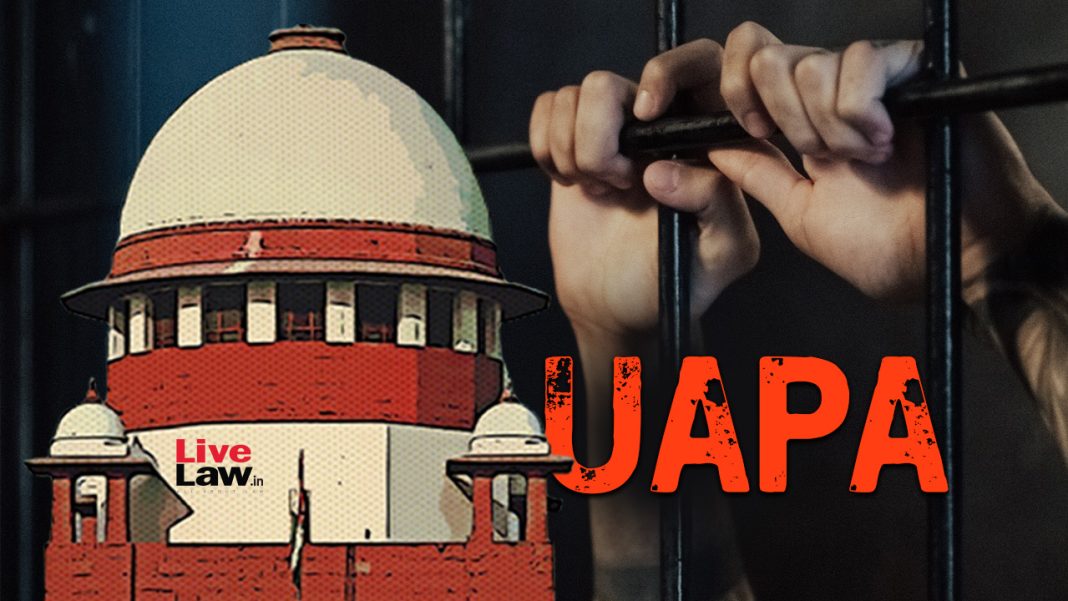
In a powerful assertion of fundamental rights, India’s Supreme Court recently delivered a scathing indictment of the prolonged detention of an individual accused under the stringent Unlawful Activities (Prevention) Act (UAPA). The Court expressed profound shock and labelled it “appalling” that an accused had been held in custody for two years without even a chargesheet being filed by the investigating agency. This landmark observation led to the immediate grant of bail, underscoring the judiciary’s unwavering commitment to due process and personal liberty, even in cases involving national security legislation.
The ruling by a bench comprising Justice Aniruddha Bose and Justice Augustine George Masih has sent ripples across legal circles and civil society, highlighting the critical balance that must be struck between state security imperatives and the constitutional rights of an individual. It serves as a stark reminder that the machinery of justice, even when addressing grave allegations, cannot disregard the basic tenets of a fair and timely legal process.
The Supreme Court’s Stern Rebuke
The case revolved around an individual accused under the UAPA, a law notorious for its stringent provisions and the difficulty it poses for accused persons to secure bail. What caught the Supreme Court’s attention was not just the nature of the charges, but the egregious delay in the investigative process. Two years passed without the investigating agency, typically the National Investigation Agency (NIA), filing a chargesheet – a fundamental document outlining the alleged offences and evidence.
The bench unequivocally stated that such a prolonged detention without formal accusation was utterly unacceptable. “We are appalled by the fact that for two years, no chargesheet has been filed,” observed the Justices. This sentiment reflects a deep concern for the erosion of procedural safeguards, especially when an individual’s liberty is at stake. The Court emphasized that while the UAPA deals with serious offences, the process established by law must still be followed rigorously. The absence of a chargesheet for such an extended period effectively meant an individual was incarcerated based on mere suspicion, without the formal groundwork required for a trial to even commence.
Understanding the UAPA Conundrum
The Unlawful Activities (Prevention) Act is India’s primary legislation to combat terrorism and unlawful associations. Its provisions are stringent, granting wide powers to investigating agencies and making bail notoriously difficult to obtain. Under Section 43D(2) of the UAPA, the investigating agency generally has 90 days to complete an investigation and file a chargesheet, which can be extended to 180 days by the court under specific circumstances. Beyond this period, if no chargesheet is filed, the accused is ordinarily entitled to ‘default bail’. However, the present case appears to have transcended even these extended timelines, leading to the Supreme Court’s severe disapproval.
Critics of the UAPA often point to its potential for misuse and the adverse impact it has on fundamental rights, particularly the right to a speedy trial and personal liberty. The Supreme Court’s intervention, therefore, becomes crucial in reinforcing the constitutional safeguards that must operate even within the framework of a stringent law like UAPA. It reiterates that extraordinary laws do not grant unbridled power to the state to detain individuals indefinitely without adhering to legal timelines and due process.
Implications for Due Process and Personal Liberty
This ruling is a significant victory for the principles of natural justice and individual freedom. It sends a clear message to investigating agencies across the country that delays in investigation, especially when they lead to prolonged incarceration, will not be countenanced by the apex court. The Supreme Court’s pronouncement reinforces the constitutional guarantee under Article 21, which protects the right to life and personal liberty, including the right to a fair and speedy trial.
The Court’s decision to grant bail in this specific case, despite the serious nature of UAPA charges, underscores the judiciary’s role as the ultimate guardian of fundamental rights. It also reminds the state that its power to curtail liberty, even in the interest of national security, is not absolute and must always be exercised within the bounds of the law. While the fight against unlawful activities remains paramount, the methods employed must always uphold the dignity and rights of individuals.
This judgment will likely serve as a crucial precedent, urging investigating agencies to expedite their processes and courts to scrutinize prolonged detentions more closely, particularly under laws that have a direct bearing on civil liberties. It’s a powerful affirmation that justice delayed is indeed justice denied, and that no citizen, however grave the accusation, should languish indefinitely in custody without formal charge.

