


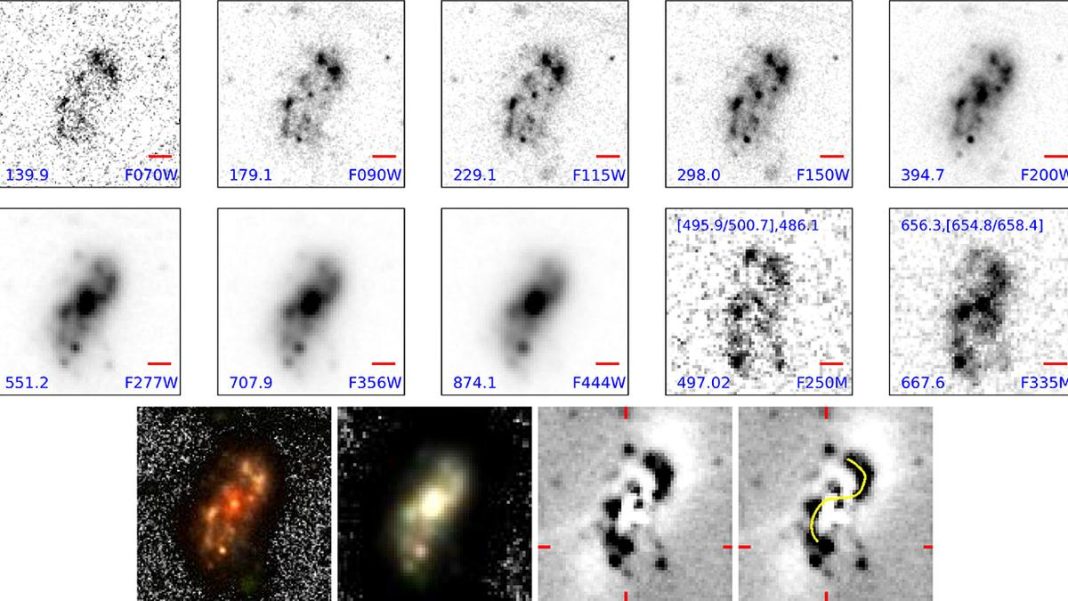
The cosmos is a tapestry woven with stars, galaxies, and mysteries that continually challenge our understanding. Recently, Indian astronomers have added a significant new thread to this cosmic fabric with the discovery of “Alaknanda,” a spiral galaxy so ancient it defies current cosmological models. Named after one of India’s sacred rivers, this celestial body is not just another distant light; it’s a profound cosmic anomaly, prompting a re-evaluation of how and when the universe’s grand structures truly began to take shape. Its existence pushes the boundaries of our knowledge, offering a rare glimpse into the universe’s infancy, an era previously thought too nascent for such complex galactic forms.
The Enigma of Alaknanda: A Cosmic Anomaly
The discovery, made by a collaborative team of Indian astrophysicists utilizing advanced observational techniques, pinpoints Alaknanda at an astonishing distance, implying we are seeing it as it existed billions of years ago, a mere fraction of a billion years after the Big Bang. According to the prevailing models of galaxy evolution, the early universe was a turbulent place, dominated by smaller, irregular galaxies that merged over eons to gradually form the more ordered, majestic spirals we observe today. Spiral galaxies, with their distinct arms and central bulges, are considered relatively mature structures, typically expected to emerge much later in cosmic history.
Alaknanda challenges this conventional timeline dramatically. Its well-defined spiral arms and organized structure at such an early epoch present a formidable puzzle. For context, most galaxies observed at similar “lookback times” (the time it takes for light to reach us from distant objects) are often small, clumpy, and still in the chaotic throes of formation. The sheer existence of a fully fledged spiral galaxy like Alaknanda so early suggests that the processes of galaxy assembly might have been far more efficient, or perhaps different mechanisms were at play than previously theorized. This isn’t just an outlier; it’s a potential game-changer for theoretical astrophysics.
Rewriting the Early Universe’s Narrative
The implications of Alaknanda’s discovery extend far beyond merely cataloging a new galaxy. It forces astronomers to reconsider fundamental aspects of galaxy formation, dark matter distribution, and even the conditions of the early universe. Could dense pockets of matter have formed faster than anticipated, providing the necessary gravitational scaffolds for such early spirals? Or perhaps our models of star formation and galactic assembly need significant revisions? The answers could redefine our understanding of cosmic evolution.
“This discovery of Alaknanda is akin to finding an ancient, fully developed city in a place where we only expected to see scattered villages,” explains Dr. Kavita Sharma, a lead astrophysicist on the project from the Raman Research Institute. “It fundamentally challenges our chronological understanding of structure formation and suggests that the universe might have matured in certain regions much faster than our current theories allow. It’s a thrilling, yet humbling, moment for cosmology.”
This monumental finding underscores India’s burgeoning capabilities in frontier astronomical research. Teams across institutions are leveraging indigenous expertise and international collaborations to push the boundaries of cosmic discovery. The meticulous analysis required to confirm Alaknanda’s age and morphology speaks volumes about the growing sophistication of Indian astronomical observatories and data interpretation techniques.
India’s Growing Prowess in Cosmic Exploration
The identification of Alaknanda is not an isolated event but a testament to India’s steady ascent in the global astronomical community. Facilities like the Giant Metrewave Radio Telescope (GMRT) in Maharashtra, one of the world’s largest and most sensitive radio telescopes, and the Ultraviolet Imaging Telescope (UVIT) on board India’s multi-wavelength satellite ASTROSAT, have been instrumental in various groundbreaking observations. While the specific instruments for Alaknanda’s initial detection might vary, the robust ecosystem of Indian scientific institutions, skilled astronomers, and access to sophisticated data analysis tools makes such discoveries possible.
This particular finding positions India at the forefront of a crucial cosmological debate. It demonstrates the nation’s capacity not just to participate in global science but to lead significant paradigm shifts. The pursuit of such deep-sky objects requires immense precision, advanced instrumentation, and a deep theoretical understanding—areas where Indian scientists are increasingly excelling. The “Make in India” ethos is extending even to the vast expanses of space, with indigenous technologies and homegrown talent driving significant advancements.
Alaknanda stands as a silent sentinel in the early universe, a beacon challenging long-held assumptions about cosmic evolution. Its existence compels the scientific community to embark on deeper investigations, refining models and perhaps even paving the way for entirely new theories of galaxy formation. For India, this discovery is a source of immense pride, highlighting its indispensable role in unraveling the universe’s grandest secrets. As astronomers continue to peer further into the cosmic past, Alaknanda reminds us that the universe always holds more wonders, and more questions, than we can ever anticipate, especially when viewed through the keen eyes of dedicated researchers.

