


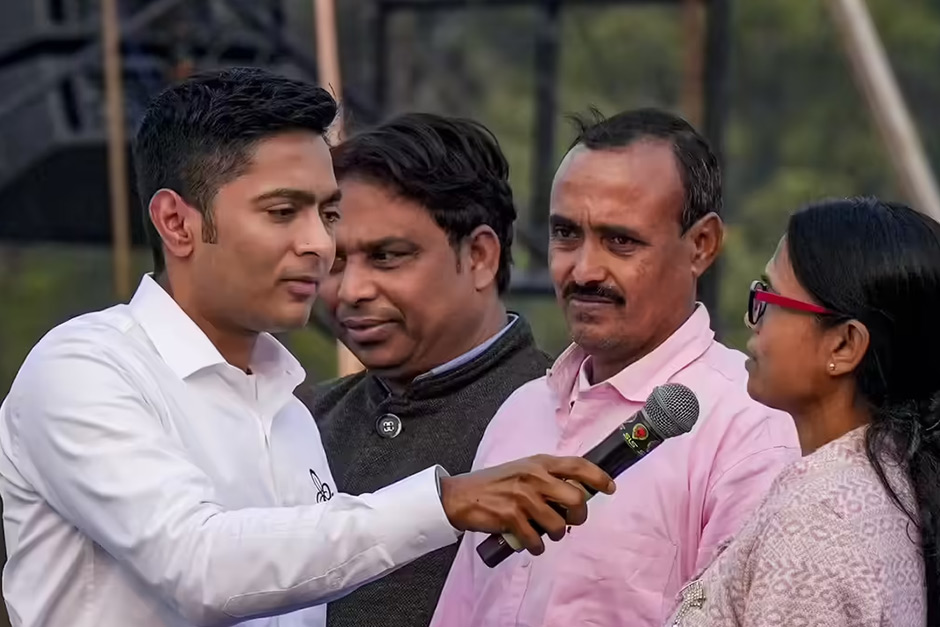
In a politically charged event that has sent ripples across West Bengal’s electoral landscape, Trinamool Congress (TMC) General Secretary Abhishek Banerjee dramatically presented three individuals at a recent rally, claiming they were erroneously marked as ‘dead’ in the official electoral rolls. The incident, which unfolded in Purba Medinipur, has ignited a fresh round of accusations against the Election Commission of India (ECI) and the Bharatiya Janata Party (BJP), intensifying the debate over electoral integrity ahead of crucial elections.
Banerjee, a prominent figure in the TMC and nephew of Chief Minister Mamata Banerjee, used the platform to directly challenge the fairness and accuracy of the voter registration process. His presentation of the allegedly ‘dead but alive’ voters was a potent visual, designed to underscore his party’s long-standing concerns about potential manipulation and disenfranchisement.
The Shocking Revelation in Purba Medinipur
The rally in Purba Medinipur, a district often at the heart of West Bengal’s political battles, became the stage for Banerjee’s startling claim. Addressing a massive gathering, he introduced three residents – two men and one woman – asserting that official records listed them as deceased, thereby stripping them of their fundamental right to vote. These individuals, visibly present, stood as living proof against the alleged discrepancies in the electoral roll. Banerjee contended that such errors were not mere administrative oversights but indicative of a deeper, more insidious agenda.
The TMC leader meticulously detailed the cases, stating that these voters had been actively participating in democratic processes until recently. Their sudden disappearance from the ‘alive’ list, he argued, raised serious questions about the methodologies and motivations behind the updates to the electoral database. He specifically highlighted that if these individuals, who were very much alive and local residents, could be declared dead, then the integrity of the entire voter list was compromised, potentially impacting thousands of voters across the state. This move was clearly calculated to put the ECI under immense pressure to explain the alleged lapses.
Accusations Fly: EC’s Role and BJP’s Alleged Hand
Abhishek Banerjee’s direct challenge extended beyond just the ECI, firmly placing the blame at the doorstep of the BJP. He alleged that the discrepancies were part of a deliberate conspiracy orchestrated by the saffron party to disenfranchise TMC supporters and manipulate the electoral outcome. “The BJP, in its desperation, is stooping to new lows, conspiring to remove eligible voters from the list,” Banerjee declared, adding, “This is not an error; it’s a planned attempt to undermine democracy, with the Election Commission seemingly turning a blind eye or being complicit.”
The TMC’s contention is that the ECI, which is constitutionally mandated to ensure free and fair elections, has failed in its duty to maintain an accurate and impartial voter database. They argue that the ECI’s reliance on Booth Level Officers (BLOs), many of whom are state government employees, needs stricter oversight to prevent political influence. This incident, according to TMC, exposes a systemic vulnerability that could be exploited for political gain, especially in a state known for its fierce electoral contests.
BJP’s Response and the EC’s Challenge
In response to Banerjee’s allegations, the BJP in West Bengal swiftly dismissed the claims as a “political gimmick” and a “desperate attempt” by the TMC to divert attention from its own internal issues and alleged corruption. BJP leaders contended that errors in electoral rolls are not uncommon and occur due to various reasons, including changes in residence, death, or administrative mistakes, and that there are established procedures for correction. They questioned why the TMC, if it truly believed in these claims, did not approach the ECI through formal channels earlier rather than making a public spectacle at a rally. Senior BJP leader Shishir Bajoria remarked, “The TMC is known for its drama. If they have genuine concerns, they should follow due process. This is merely a stunt to create unnecessary controversy and discredit institutions.”
The ECI, on its part, faces the formidable task of upholding public trust amidst such serious allegations. While the Commission typically encourages citizens to verify their details and file claims or objections through Form 6 (for inclusion), Form 7 (for objection/deletion), and Form 8 (for correction), incidents like these amplify scrutiny. The ECI’s ongoing efforts to digitize records and conduct special summary revisions are aimed at improving accuracy, but the sheer scale of the Indian electorate makes the process challenging. The EC has yet to issue a direct statement specifically addressing Banerjee’s latest accusations, but it is expected to review the presented cases and initiate necessary inquiries.
The Broader Implications for Electoral Integrity
The controversy surrounding the “dead” voters transcends the immediate political sparring between TMC and BJP. It strikes at the very heart of electoral integrity, which is the bedrock of any functioning democracy. Accurate voter lists are paramount to ensuring every eligible citizen can exercise their franchise and that no fraudulent votes are cast. Allegations of deliberate manipulation or gross negligence in voter list management can significantly erode public confidence in the electoral system, leading to cynicism and distrust.
As India gears up for upcoming elections, such incidents serve as a potent reminder of the continuous need for vigilance, transparency, and robust oversight in the electoral process. The responsibility lies not only with the Election Commission to maintain impeccable records but also with political parties to engage constructively and with citizens to actively participate in the verification and correction processes. The true test for democracy lies in its ability to inspire faith in its foundational processes, and events like the one in Purba Medinipur underscore the fragility of that trust when questions of fairness arise.
The coming weeks will likely see further developments as the ECI is pressed for answers and political parties continue their high-stakes electoral campaigns, with voter list accuracy remaining a contentious and critical issue.

