


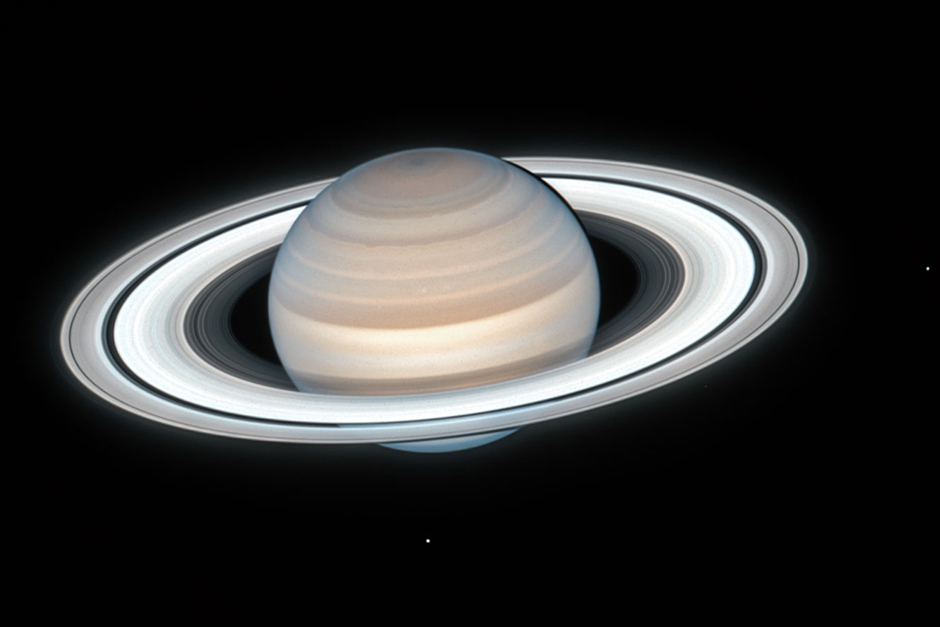
Saturn’s rings are an undeniable marvel, a glittering halo that defines one of our solar system’s most iconic planets. For centuries, they have captivated observers and puzzled scientists, prompting questions about their origins and age. While many theories have been proposed, a new study offers a compelling explanation, suggesting that these magnificent rings may be the relatively recent outcome of a dramatic cosmic collision: two moons crashing together about 100 million years ago.
Unraveling the Mystery of Saturn’s Rings
For a long time, the leading hypotheses about Saturn’s rings generally fell into two camps. Some suggested the rings were primordial, ancient material left over from the formation of the solar system that never coalesced into a moon. Others posited that they were the shattered remnants of a larger moon that drifted too close to Saturn and was torn apart by the planet’s immense gravitational forces. The challenge has always been to reconcile the rings’ apparent “youth” – their bright, icy composition suggests they haven’t been around long enough to be significantly darkened by space dust – with the age of the solar system itself.
Recent observations, particularly from the Cassini mission, have provided unprecedented data on the rings’ mass, composition, and dynamics. These insights, combined with advanced computational modeling, have allowed researchers to re-evaluate older theories and explore new ones. The idea of a recent origin for the rings has gained traction, but the precise mechanism remained elusive until now.
The Violent Birth: Two Moons Collide
The new study introduces a fascinating scenario: an ancient ice-rich moon, perhaps similar in size to some of Saturn’s current mid-sized moons, already orbiting the gas giant. This moon, nicknamed “Chrysalis” by some researchers, then entered a period of orbital instability. It’s theorized that this instability could have been triggered by the gravitational influence of Neptune, pushing Saturn’s orbit slightly and, in turn, subtly altering the orbits of its inner moons.
Instead of merely breaking apart due to tidal forces, the study suggests this moon collided with another, smaller icy satellite. The impact wouldn’t have necessarily destroyed both bodies completely, but rather shattered them into countless pieces, creating a vast disk of debris. This debris, rich in ice, would then have gradually spread out and flattened into the thin, wide ring system we observe today. The timing of this proposed collision, approximately 100 million years ago, aligns well with the “young” age estimated for the rings based on their pristine appearance.
“This hypothesis offers an elegant solution to several long-standing puzzles about the rings,” explains a theoretical planetary scientist, Dr. Anya Sharma. “It explains their high ice content, their relatively recent formation, and the dynamic processes that could have led to such a catastrophic event. It’s a testament to how complex and active our solar system remains, even billions of years after its formation.”
Implications for Understanding Our Solar System
This “two moons crashing” model not only provides a compelling explanation for Saturn’s rings but also offers broader insights into planetary system dynamics. It highlights that planetary systems are not static; rather, they are constantly evolving through gravitational interactions, orbital migrations, and even dramatic collisions. Such events could be more common than previously thought, shaping the landscapes of distant planets and their accompanying satellites in profound ways.
Further research will undoubtedly focus on refining the models, exploring the exact conditions that would lead to such a collision, and searching for subtle clues within the rings themselves that could corroborate this intriguing narrative. The study serves as a powerful reminder that even the most familiar celestial objects hold secrets waiting to be uncovered, continually reshaping our understanding of the universe.

