


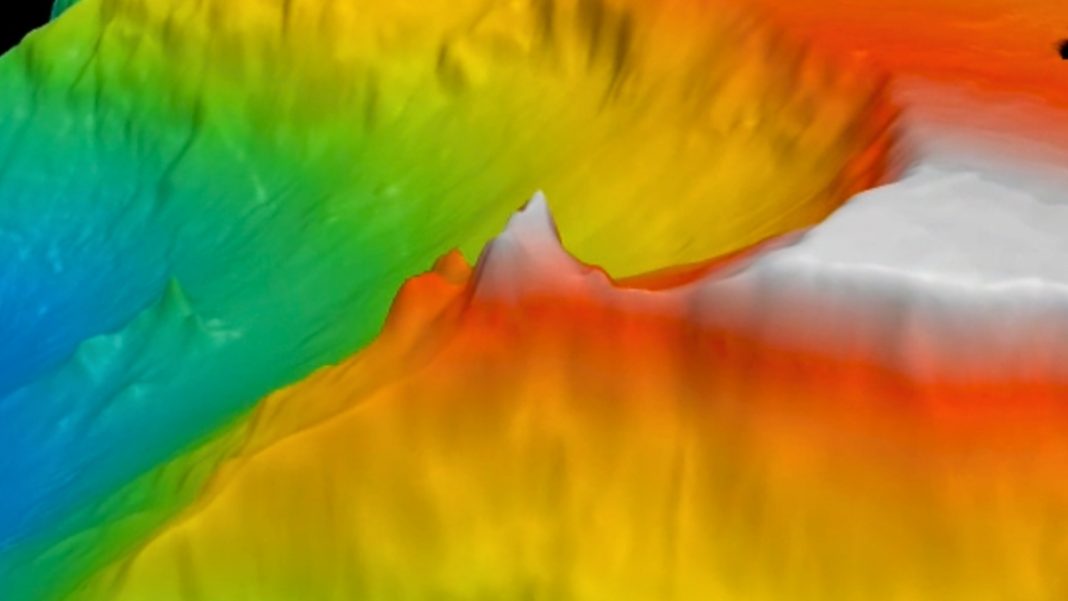
Prepare to have your perception of Earth’s hidden realms shattered. Far beneath the vast, blue expanse, in a place of eternal darkness and crushing pressure, scientists have stumbled upon a discovery that rewrites our understanding of life and geology: a “Lost City” deep beneath the ocean unlike anything we’ve ever seen before. This isn’t just another shipwreck or a coral reef; it’s a monumental, mineral marvel sculpted by Earth’s own geological forces, teeming with life in conditions previously thought impossible.
A Deep-Sea Anomaly Born of Earth’s Own Alchemy
Unlike the more common and fiery “black smoker” hydrothermal vents that dot the ocean floor, this “Lost City” operates on a fundamentally different principle. It’s a field of hydrothermal vents powered by a process called serpentinization. This occurs when seawater seeps into the ocean crust and reacts with rocks from the Earth’s mantle, particularly olivine. This chemical dance creates a warm, alkaline fluid rich in hydrogen, methane, and other hydrocarbons – a stark contrast to the superheated, acidic output of black smokers.
What makes this so extraordinary? For one, the chemistry. The unique environment fosters entirely different microbial communities, suggesting a parallel pathway for life to evolve and thrive without sunlight. Furthermore, these vents are remarkably long-lived. While black smokers are often fleeting geological phenomena, the Lost City hydrothermal field has been active for an estimated 120,000 years or more, providing a stable, enduring haven for its peculiar inhabitants.
Towering Wonders and Life Beyond Light
Imagine a surreal cityscape carved not from concrete and steel, but from gleaming white carbonate minerals. That’s the visual spectacle of the Lost City. Towering structures, some reaching over 60 meters (nearly 200 feet) tall, dominate the abyssal landscape. These are not volcanic cones, but intricate chimneys and spires formed by the slow precipitation of minerals from the warm, alkaline fluids. The largest of these magnificent formations has been aptly named “Poseidon,” standing as a silent, majestic sentinel in the deep.
Through countless vents and fissures, fluids bubble forth, creating a mesmerizing shimmer. This gentle flow, combined with the unique mineralogy, supports an ecosystem utterly reliant on chemosynthesis – where microbes derive energy from chemical reactions rather than sunlight. These microbes form the base of a food web that sustains unique species of snails, crabs, amphipods, and other invertebrates, perfectly adapted to this otherworldly environment.
“It’s like stumbling upon an alien cityscape,” mused Dr. Evelyn Reed, a marine geochemist, during a recent virtual seminar. “The sheer scale and the intricate architecture are breathtaking, a testament to Earth’s profound geological artistry, and a crucible for life unlike anything we thought possible.” This truly puts into perspective the monumental nature of this discovery.
Implications for Earth and Beyond
The discovery of the Lost City isn’t just a stunning visual; it’s a scientific goldmine. Its unique chemistry and geology offer unparalleled insights into the origin of life on Earth. Many scientists hypothesize that similar environments could have nurtured the very first life forms on our planet, long before photosynthesis evolved. Studying the extremophiles that thrive here could reveal new metabolic pathways and biochemical compounds with profound implications for biotechnology and medicine.
Moreover, the Lost City serves as a terrestrial analogue for potential extraterrestrial life. Moons like Jupiter’s Europa and Saturn’s Enceladus are thought to harbor vast subsurface oceans interacting with rocky cores. If life exists on these celestial bodies, it might well resemble the chemosynthetic ecosystems found in our own deep-sea Lost City, surviving on chemical energy in the absence of sunlight. This discovery pushes the boundaries of where we expect to find life, expanding the habitable zones not just on Earth, but potentially across the cosmos.
The Lost City stands as a powerful reminder of how much remains unknown about our own planet. It beckons us to continue exploring the deep, to push the limits of our technology and imagination, because clearly, the Earth still holds secrets far more astonishing than we can possibly conceive.

