


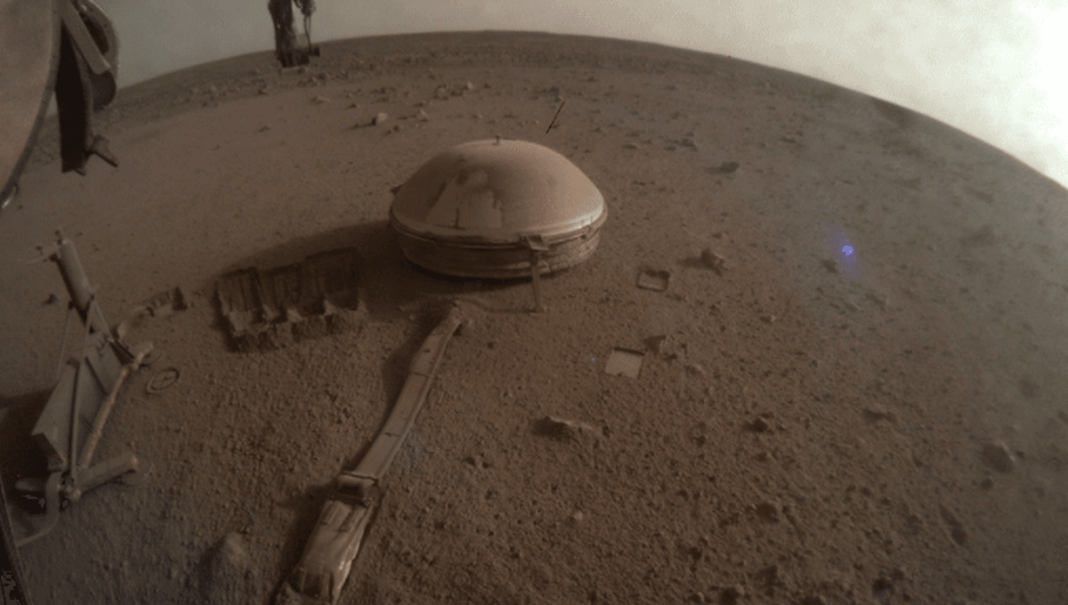
Imagine peering through a cosmic telescope, studying a familiar celestial body, only to discover it’s subtly changing right before our very eyes. That’s precisely the fascinating, head-scratching situation unfolding on Mars. Our dusty red neighbor, the subject of countless probes and endless fascination, appears to be picking up speed. And the most tantalizing part? Scientists suspect a colossal, utterly unexplained mass deep within its core is the culprit. It’s a cosmic riddle that’s turning our understanding of planetary mechanics on its head.
The Red Planet’s Accelerating Mystery
For years, missions like NASA’s InSight lander have provided invaluable data, meticulously tracking Mars’ rotation. What they’ve revealed is astonishing: the planet’s spin rate is not constant; it’s accelerating by about four milliarcseconds per year. While that might sound minuscule, over geologic timescales, it’s a significant shift. This isn’t just a minor wobble; it’s a fundamental change in the planet’s dynamics. The only plausible scientific explanation for such an acceleration is a redistribution of mass within the planet itself – specifically, a dense, heavy concentration of material deep inside that’s shifting and causing Mars to spin faster, much like a figure skater pulling their arms in.
But here’s where the mystery truly begins: we have absolutely no idea what this mass is. It’s a gargantuan, invisible anchor, exerting its unseen influence from the Martian depths. We’ve mapped the surface, probed the crust, and even inferred the general structure of its core, but this specific, accelerating mass remains an enigma. It challenges our established models and reignites the fires of cosmic curiosity.
What Unseen Force Lurks Below?
The scientific community is buzzing with speculation. What could possibly be this enormous, unseen entity driving Mars to spin faster? Could it be a colossal reservoir of denser-than-expected material sinking towards the core, much like heavy sediments settling in a vast, ancient ocean? Perhaps it’s a unique geological feature, an anomaly in the Martian mantle or core that formed during the planet’s tumultuous early history. Some theories even cautiously suggest the possibility of previously unknown geophysical processes at play, challenging our assumptions about how planetary interiors evolve.
“It’s like finding a giant, invisible weight shifting within a spinning top – completely upending our models of Martian internal dynamics,” mused Dr. Lena Petrova, a hypothetical planetary geophysicist speaking at a recent virtual symposium. “This discovery forces us to reconsider everything we thought we knew about the red planet’s deep structure and its long-term evolution. The data is clear, but the explanation is profoundly elusive.”
Whatever its nature, this hidden mass isn’t just a curious anomaly; it holds the potential to rewrite chapters in our planetary science textbooks. Understanding its composition, origin, and movement could reveal unprecedented insights into Mars’ past, its potential for past habitability, and even its future geological activity. It’s a tantalizing puzzle, pushing the boundaries of our observational capabilities and our theoretical frameworks.
The Search for Answers Continues
The revelation of Mars’ accelerating spin, driven by an unknown internal mass, is more than just a scientific curiosity; it’s a powerful reminder of how much remains to be discovered even about our closest cosmic neighbors. Each new piece of data from orbiting spacecraft and intrepid landers chips away at the unknown, but sometimes, those chips reveal even deeper, more profound mysteries. The search for what lies beneath Mars’ accelerating surface will undoubtedly shape future missions and inspire a new generation of scientists to look inward – literally – to unlock the secrets of planetary evolution. Until then, Mars continues its cosmic ballet, spinning a little faster, holding its greatest secret close to its heart.

