


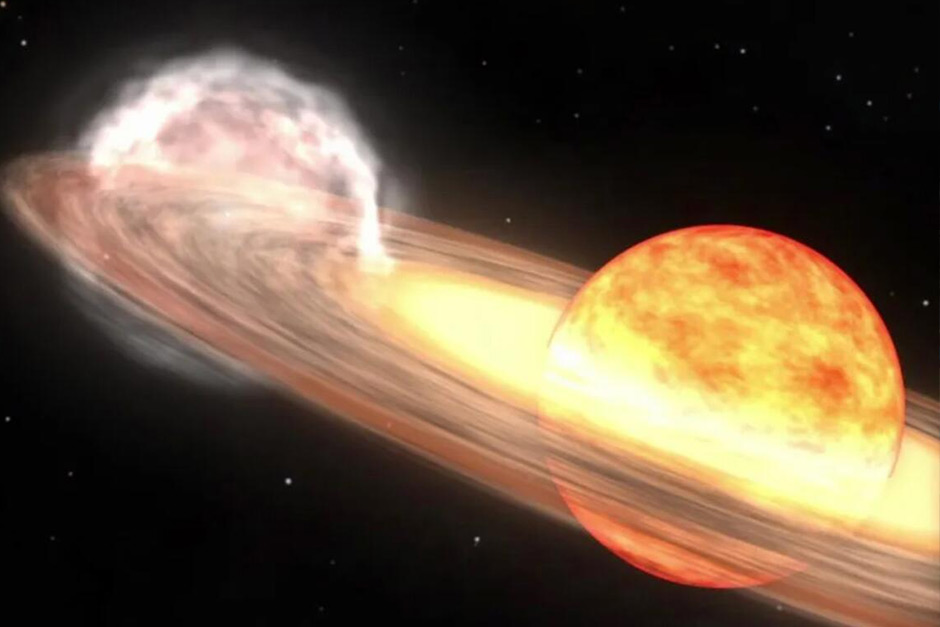
Imagine a celestial titan, a star so vast it dwarfs our Sun, undergoing dramatic changes. For astronomers and enthusiasts alike, there’s a particular kind of thrill—and a touch of cosmic anxiety—when one of these stellar behemoths begins to show signs that its time might be drawing to a close. We’re talking about a red supergiant, a star in its elder years, flickering and fluctuating in ways that suggest an explosive finale could be on the horizon. This isn’t just a distant spectacle; it’s a front-row seat to one of the universe’s most powerful events, and the whispers across the scientific community are growing louder: a huge star is changing, and it could be about to explode.
The Fickle Heart of a Dying Star
Red supergiants are truly immense, hundreds, sometimes even a thousand times the diameter of our Sun. They burn through their nuclear fuel at an astonishing rate, living fast and dying young in cosmic terms. As they exhaust the hydrogen in their core, they expand enormously, cool down, and begin to fuse heavier elements. This process is inherently unstable, leading to the dramatic shifts we’re currently observing in certain stars. Recent observations have shown significant dimming and brightening cycles, along with noticeable changes in their perceived shape and surface activity. These aren’t just minor fluctuations; they are the stellar equivalent of a very old person struggling to breathe, signaling that the end of its life cycle is approaching.
What exactly causes these changes? It’s a complex interplay of internal processes. The star’s core is undergoing rapid transformations, creating immense internal pressure and temperature fluctuations. This can cause vast plumes of gas and dust to be ejected from its surface, sometimes temporarily shrouding the star and making it appear dimmer from Earth. Other times, internal convection cells on the star’s surface, far larger than anything we see on the Sun, can shift and change, altering the overall brightness and even the perceived “roundness” of the star. These aren’t just fascinating details; they are critical clues for astrophysicists trying to piece together the final agonizing moments of a star’s life before it goes supernova.
The Cosmic Countdown: What Happens Next?
When a star of this magnitude finally collapses under its own immense gravity, it doesn’t just fade away. It detonates in a cataclysmic explosion known as a Type II supernova. This event is incredibly powerful, briefly outshining an entire galaxy. From Earth, if the star is within a few hundred light-years, it would become visible even in daylight, appearing as a brilliant beacon in the sky for weeks or even months. Imagine a second, utterly spectacular “sun” appearing overnight, gradually dimming over time. This would be an unprecedented astronomical event for humanity, a once-in-a-millennium viewing opportunity.
While the idea of a nearby supernova might sound alarming, scientists assure us there’s no immediate danger to Earth from any known supergiant showing these signs. The distances involved are still vast enough to protect us from the dangerous radiation. However, the scientific value would be immeasurable. We would gain invaluable real-time data on the physics of stellar death, gravitational waves, and the creation of heavy elements that are essential for life. As Dr. Lena Petrova, a leading astrophysicist, aptly puts it, “These moments of stellar instability are like a preview of the main event. Every flicker, every change in brightness, is a data point bringing us closer to understanding how the universe’s most spectacular explosions truly work.” The supernova would also leave behind a neutron star or a black hole, depending on the star’s initial mass, further enriching our understanding of cosmic remnants.
The universe is a dynamic place, full of birth, life, and death on scales we can barely comprehend. The potential impending explosion of a huge star is a profound reminder of this cosmic ballet. It’s a chance to witness, from a safe distance, the awesome power that sculpts galaxies and creates the very elements we are made of. This isn’t just astronomy; it’s a peek into the engine room of existence, a spectacular cosmic warning that even giants eventually fall, only to give birth to something new and extraordinary.

