


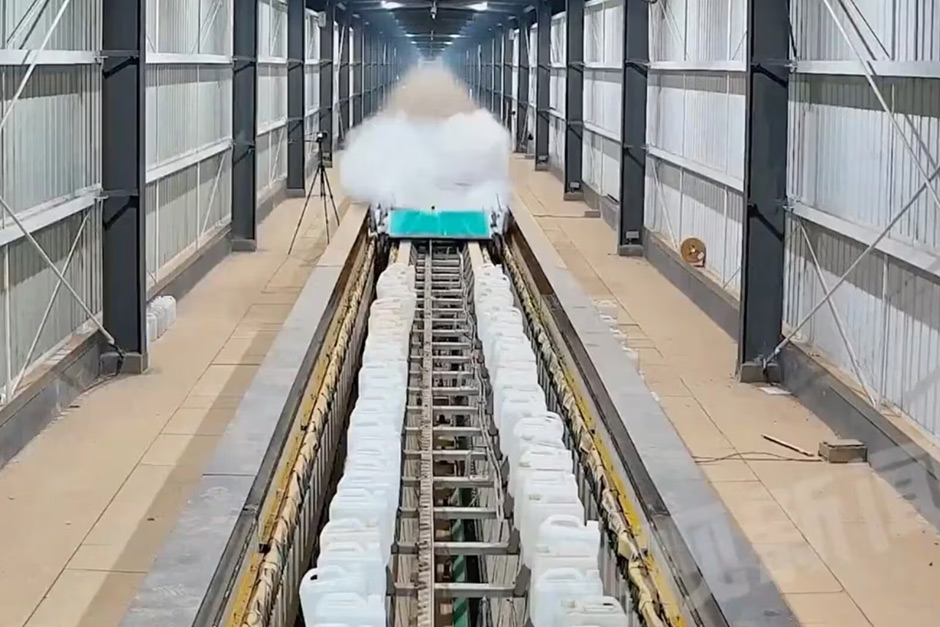
The world of high-speed transportation just got a significant jolt, thanks to China’s latest engineering marvel. Headlines have been ablaze, sensationalizing a figure that sounds almost fantastical: a train capable of reaching ‘700 kmph in just 2 seconds’. While the exact phrasing might capture the sheer audacity of modern locomotion, it’s essential to dive into the facts. China has indeed unveiled its new magnetic levitation (maglev) train, positioning it as the fastest ground vehicle globally, boasting an operational top speed of 600 kmph. This astonishing capability to accelerate and sustain such speeds is what underpins the viral excitement, showcasing a leap in transport technology that promises to redefine travel.
This development isn’t merely about a number; it represents a monumental achievement in engineering, pushing the boundaries of what’s possible for mass transit. For a nation like India, which is fervently pursuing its own high-speed rail ambitions, China’s maglev offers a fascinating glimpse into a future that might still be distant but is undeniably captivating. It raises questions about infrastructure, investment, and the ultimate vision for connectivity across diverse terrains.
The Science of Speed: Unpacking Maglev Technology
At the heart of China’s new record-setter lies magnetic levitation, a technology that has been refined over decades. Unlike conventional trains that run on wheels and tracks, maglev trains literally float above the guideway, propelled and guided by powerful electromagnets. This eliminates friction, the primary impediment to speed and efficiency in traditional rail systems. The result is an incredibly smooth, quiet, and rapid journey.
The new Chinese maglev, developed by China Railway Rolling Stock Corporation (CRRC) and launched from Qingdao, Shandong province, is designed to fill a crucial gap in the country’s transport network – bridging the speed difference between high-speed rail and air travel. While its sensational acceleration to very high speeds quickly might have been interpreted as “700 kmph in 2 seconds” in some reports, its sustained top speed of 600 kmph is what makes it a world-beater for ground transport. This speed allows it to cover vast distances in significantly reduced times, for instance, potentially cutting a 1,000 km journey from 10 hours by conventional train to just 2.5 hours, including station stops. The sheer engineering prowess required to achieve and maintain such speeds, along with the precise control of magnetic forces, is what truly sets this train apart.
Global Race and Indian Aspirations in High-Speed Rail
China’s latest achievement places it firmly at the forefront of the global high-speed rail race, joining nations like Japan and Germany which have also experimented with maglev technology. Japan’s L0 Series maglev, for instance, has achieved test speeds exceeding 600 kmph, though it is not yet fully operational for commercial passenger service. These advancements underscore a worldwide commitment to faster, more efficient, and sustainable transport solutions.
For India, a nation characterized by its vast geography and burgeoning economy, the pursuit of high-speed rail is a strategic imperative. The ongoing Mumbai-Ahmedabad bullet train project, utilizing Japanese Shinkansen technology, represents India’s significant foray into the realm of rapid rail. While India’s current focus remains on conventional high-speed rail – which offers a proven, albeit slower, solution compared to maglev – the developments in China naturally spark conversations about future possibilities.
However, the journey towards widespread maglev implementation is fraught with challenges, particularly for a country like India. The primary hurdle is the immense cost associated with dedicated infrastructure. Maglev trains require entirely new, specially constructed elevated guideways, which are far more expensive to build than conventional rail lines. Land acquisition, already a complex issue for existing infrastructure projects, would be even more formidable for such a specialised system. Furthermore, the operational costs and the need for a highly skilled workforce to maintain such advanced technology present substantial considerations. As an expert in urban mobility, Dr. Riya Sharma, recently observed, “While the allure of maglev technology is undeniable, for developing economies like India, striking a balance between cutting-edge innovation and practical, scalable solutions remains paramount for the foreseeable future.”
The Road Ahead: Innovation and Integration
The introduction of China’s 600 kmph maglev train is more than just a technological marvel; it’s a statement about the relentless pursuit of progress. It pushes the boundaries of what high-speed ground transport can achieve, setting a new benchmark for speed, efficiency, and potentially, sustainability if powered by green energy sources.
While the immediate adoption of maglev technology in India might be a distant dream given the significant infrastructural and financial commitments required, China’s success serves as a powerful catalyst for innovation. It encourages research and development, not just in maglev but in all facets of high-speed transportation, including more efficient conventional high-speed rail systems, better track materials, and advanced signalling technologies. For India, this means continuously evaluating its strategic choices, learning from global advancements, and progressively upgrading its own transportation backbone to meet the demands of a rapidly growing population and economy.
Ultimately, the “700 kmph in just 2 seconds” headlines, even if a simplification, underscore an undeniable truth: the future of travel is getting faster. China has once again demonstrated its capabilities in large-scale infrastructure and advanced engineering, presenting a vision of connectivity that could one day transform how millions move across continents, including potentially influencing future aspirations for speed in India.

