


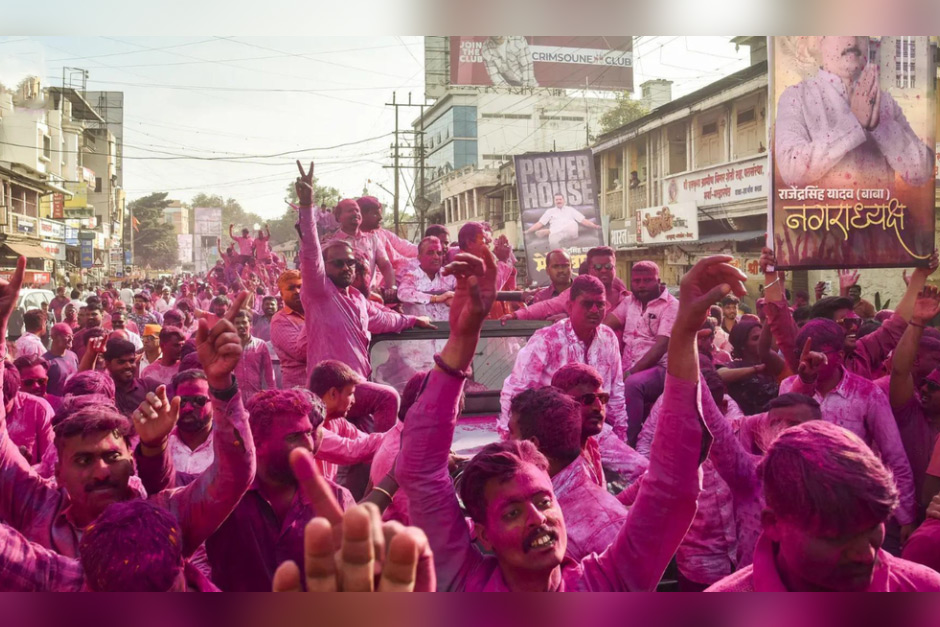
The political landscape of Maharashtra finds itself in an intriguing state of flux. While election results for 57 local bodies have been declared, bringing some clarity to the grassroots contests, a significant shadow of uncertainty persists. The ultimate political implications of these outcomes remain suspended, awaiting a crucial ruling from the Supreme Court concerning Other Backward Classes (OBC) reservation in local self-government elections. This creates a unique scenario where victories are declared, but the true picture of power distribution, and the legitimacy of certain electoral processes, hangs in the balance.
A Glimpse into Grassroots Mandates
The recently concluded elections for 57 local bodies across Maharashtra, predominantly Gram Panchayats, offered a snapshot of public sentiment at the village level. These polls, held for various vacant seats and some fresh elections, saw intense competition between the state’s major political players – the Bharatiya Janata Party (BJP), the Nationalist Congress Party (NCP), the Shiv Sena (including both Eknath Shinde and Uddhav Thackeray factions, where applicable), and the Indian National Congress. While official party lines aren’t always strictly followed in Gram Panchayat elections, where individuals often contest on local panels, the allegiance of winning candidates typically becomes clear post-results.
Initial trends and subsequent declarations indicate a mixed bag, with no single party securing an overwhelming majority across all 57 bodies. The BJP, often aligning with the Eknath Shinde-led Shiv Sena faction, has claimed significant victories in several areas, particularly in traditional strongholds and where local alliances clicked. Similarly, the Maha Vikas Aghadi (MVA) constituents – the NCP, the Uddhav Thackeray-led Shiv Sena, and the Congress – have also showcased their strength in various regions, highlighting the enduring influence of local leaders and specific issues. For instance, in districts like Ahmednagar, Pune, and Satara, results have often reflected the prevailing political dynamics of those respective regions, sometimes mirroring the broader state-level allegiances.
However, despite the celebratory declarations from various party camps, the underlying reality is that these results represent only a partial verdict. The allocation of numerous seats, specifically those reserved for OBC candidates, remains provisional. This inherent ambiguity means that while candidates have been declared winners, the final composition and political control of many of these local bodies could still undergo significant revision. Parties are, therefore, not just tallying their wins but also keenly observing the developments in the nation’s highest court, understanding that the current celebrations might be short-lived or profoundly altered.
The Supreme Court’s Shadow over OBC Reservation
The root of this unprecedented political suspense lies in the contentious issue of Other Backward Classes (OBC) reservation in local body elections. For months, Maharashtra has grappled with the legal complexities surrounding the implementation of a 27% political reservation for OBCs. The Supreme Court had previously struck down the state’s ordinance providing for this reservation, citing the failure to comply with the triple test criteria mandated by a previous apex court ruling. This triple test requires: (1) empirical data demonstrating the backwardness of the OBC community, (2) the proportion of reservation to be commensurate with the extent of backwardness, and (3) the total reservation (including SC/ST/OBC) not exceeding 50%.
Following the Supreme Court’s directive, the Maharashtra State Backward Class Commission (MSBCC) was tasked with collecting empirical data to justify the reservation. The state government subsequently filed an application in the Supreme Court, seeking permission to re-implement the 27% OBC quota based on the MSBCC’s interim report. This application is precisely what the political parties are awaiting a ruling on.
The implications of the Supreme Court’s decision are far-reaching. If the court upholds the state’s plea and allows the 27% reservation, the currently declared results for OBC seats would likely be validated, potentially leading to the formal swearing-in of elected representatives. However, if the court rejects the plea or directs a different approach, it could lead to the annulment of elections for OBC-reserved seats, fresh elections for those specific positions, or a complex re-allocation of seats based on revised reservation formulae. Such a scenario would not only delay the formation of these local bodies but could also significantly alter their political balance, forcing parties back to the drawing board to forge new alliances or contest afresh.
A seasoned political analyst, who requested anonymity due to the sensitive nature of ongoing legal proceedings, noted, “These results, while indicative of local sentiment, are fundamentally incomplete. The Supreme Court’s ruling on OBC reservation isn’t just a legal technicality; it’s the lynchpin that will determine the legitimate political structure of these 57 bodies and set a precedent for future local elections. Parties are meticulously scrutinizing every word from the court.” This sentiment underscores the profound uncertainty gripping the state’s political class.
The current political atmosphere in Maharashtra is thus characterized by a delicate balance of declared outcomes and anticipated legal pronouncements. While the successful candidates and their supporting parties are eager to assume their roles and leverage their grassroots mandates, the looming Supreme Court decision keeps everyone on tenterhooks. The true power dynamics, the final composition of the 57 local bodies, and indeed, the broader political narrative surrounding local governance in Maharashtra, will only become definitively clear once the apex court delivers its much-anticipated ruling. Until then, the state’s political chessboard remains in a strategic pause, with all eyes firmly fixed on the judiciary.

