


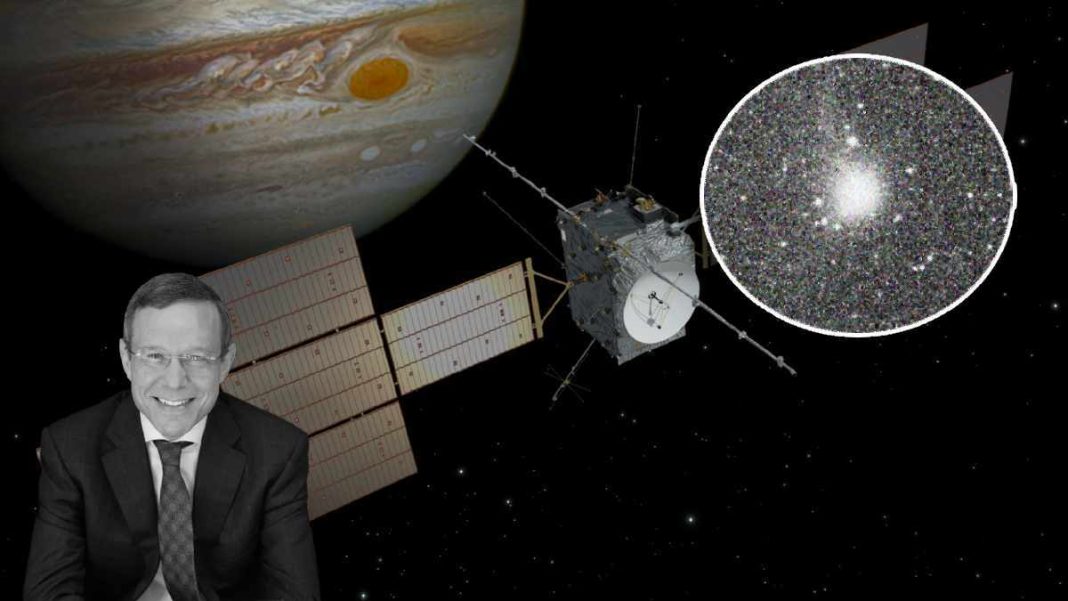
The cosmos continues to whisper its secrets, and humanity, with its ever-extending reach, is increasingly attuned to these faint yet profound messages. In a monumental journey to Jupiter’s enigmatic icy moons, the European Space Agency’s (ESA) JUpiter ICy moons Explorer (JUICE) probe has already delivered unexpected treasures. En route to its primary destination, JUICE captured images of an interstellar object, 3I/ATLAS, an encounter that has since become a focal point of discussion among astrophysicists worldwide. Leading the charge in decoding these fresh visual data is none other than Harvard Professor Avi Loeb, whose interpretations often challenge conventional wisdom and ignite spirited debate.
For a nation like India, with its rapidly growing space ambitions and a populace deeply fascinated by cosmic phenomena, such discoveries resonate profoundly. From the successful Chandrayaan missions to ambitious plans for Gaganyaan, India’s engagement with space exploration is at an all-time high, fostering a keen interest in global space endeavours and the mysteries they uncover.
Unveiling the Enigma: 3I/ATLAS and JUICE’s Glimpse
Launched in April 2023, JUICE is on a multi-year voyage designed to explore Jupiter and its three large ocean-bearing moons – Europa, Ganymede, and Callisto – in unprecedented detail. The mission aims to investigate the emergence of habitable worlds around gas giants and to study the Jovian system as an archetype for exoplanets. However, space exploration often brings serendipitous discoveries, and JUICE’s journey has already proven this adage true.
During its interplanetary cruise phase, the probe unexpectedly captured images of an interstellar visitor identified as 3I/ATLAS. This object, much like the famous ‘Oumuamua, originated from beyond our solar system, offering scientists a rare opportunity to study material from another star system. While ‘Oumuamua baffled researchers with its perplexing cigar-like shape and anomalous acceleration, 3I/ATLAS presents a fresh canvas for exploration. The images, though perhaps not high-resolution close-ups, provide crucial photometric and astrometric data that help characterize this mysterious wanderer as it traversed through our cosmic neighbourhood.
The rarity of observing such objects firsthand makes any data invaluable. JUICE’s capability to capture these images while executing complex trajectory corrections highlights the mission’s sophisticated instrumentation and the relentless vigilance of the teams operating it. For scientists, every pixel, every shift in brightness, and every subtle movement holds potential clues to its origin and composition.
Avi Loeb’s Interpretation: Decoding Interstellar Clues
Avi Loeb, a prominent theoretical physicist and head of Harvard University’s Galileo Project, is renowned for his bold hypotheses concerning interstellar objects. His past assertions about ‘Oumuamua’s potential artificial origin have stirred both excitement and controversy within the scientific community. Now, with JUICE’s new data on 3I/ATLAS, Loeb once again steps forward to offer his unique interpretations.
Loeb’s analysis focuses on interpreting the observed light curve and trajectory data from JUICE’s observations. He scrutinizes any anomalies in brightness, changes in velocity, or unusual shapes suggested by the limited data. While acknowledging the preliminary nature of the findings, Loeb posits that interstellar objects like 3I/ATLAS present a unique opportunity to search for potential extraterrestrial technology, or at the very least, exceptionally unusual natural phenomena not observed in our solar system.
His approach often involves considering what he terms “low-likelihood, high-impact” possibilities. Loeb emphasizes that simply categorizing every anomalous interstellar object as a comet or asteroid might overlook truly groundbreaking discoveries. The challenge, he notes, lies in acquiring more definitive data. Regarding 3I/ATLAS, he urges a meticulous examination of all available images and photometric data for any signatures that deviate from known natural objects.
“The data from JUICE, even preliminary, offers an unprecedented close look at an interstellar visitor,” Loeb reportedly stated during a recent virtual seminar. “Whether 3I/ATLAS proves to be a natural marvel or something more enigmatic, it underscores the profound mysteries that lie beyond our solar system and the critical role missions like JUICE play in unraveling them.”
The Path Ahead for JUICE and Cosmic Discoveries
As JUICE continues its arduous journey towards the Jovian system, scheduled to arrive in 2031, the implications of its early interstellar observations are far-reaching. The initial data from 3I/ATLAS has not only added to our understanding of the prevalence of interstellar objects but has also underscored the potential for unexpected discoveries in deep space. It serves as a potent reminder that the universe is teeming with unknown wonders, and every mission, every probe, is a step towards uncovering them.
For India, and indeed for the global scientific community, the ongoing saga of JUICE and objects like 3I/ATLAS fuels inspiration. These missions push the boundaries of technology and human ingenuity, fostering a spirit of inquiry that transcends geographical borders. The deeper JUICE delves into the cosmos, the more profound the questions it will help us answer, and the more compelling the new mysteries it will inevitably unveil.
The quest to understand our place in the universe is a continuous journey, and with every fresh picture decoded, we move closer to grasping the true expanse and complexity of the cosmos.

