


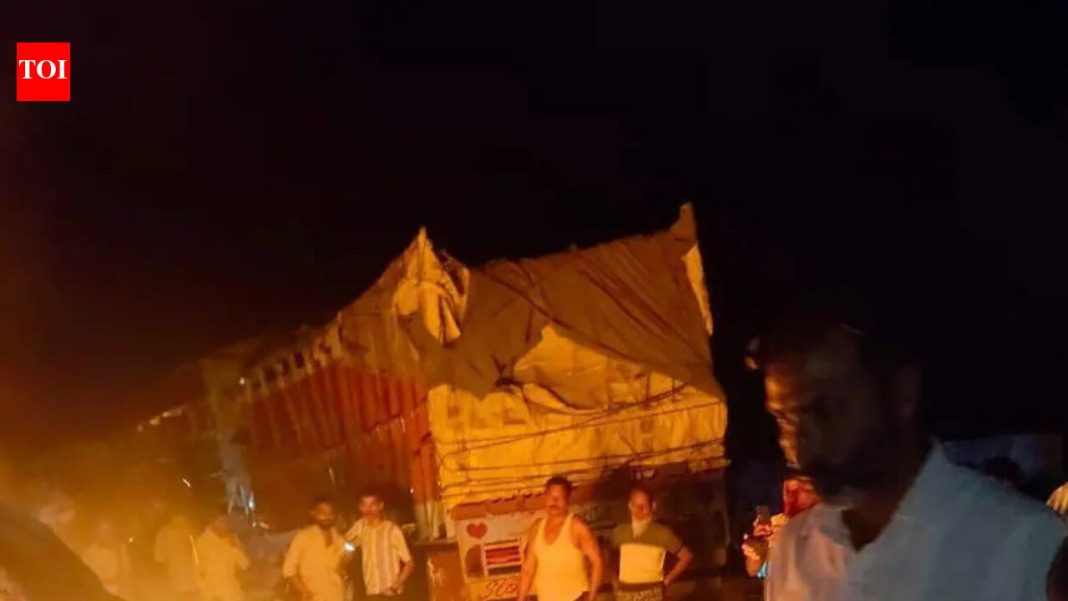
Tragedy struck Uttar Pradesh’s Mirzapur district late Tuesday evening, when a devastating multi-vehicle collision on National Highway 2 (NH-2) claimed the lives of 11 individuals and left several others critically injured. The horrific incident, which involved a truck, a utility vehicle (SUV), and a car, has plunged the region into grief and once again highlighted the urgent need for stringent road safety measures across the country.
The Horrific Incident Unfolds
The accident occurred around 10:30 PM near the Bharuhana area of Mirzapur, a stretch known for its heavy traffic flow. According to preliminary reports from local authorities and eyewitnesses, a truck, reportedly travelling at high speed, lost control and first collided with an SUV. The impact was so severe that the SUV was completely mangled, instantly killing most of its occupants. Moments later, a car approaching from the opposite direction was also caught in the chaotic aftermath, unable to avoid the debris and the initial collision.
The scene was one of utter devastation. Wreckage was scattered across the highway, and the cries of the injured mingled with the desperate efforts of initial responders – local residents who rushed to assist before emergency services could arrive. Police sources indicated that the sheer force of the collision made rescue efforts extremely challenging. Many victims were trapped inside the mangled remains of the vehicles, requiring specialized equipment to extricate them. Of the 11 fatalities confirmed, 8 were occupants of the SUV, while the remaining 3 were from the car. Several injured individuals, including the truck driver, were rushed to nearby hospitals.
Rescue Operations and Official Response
Upon receiving information about the accident, multiple police teams, ambulances, and fire tenders were dispatched to the site. The District Magistrate and Superintendent of Police of Mirzapur personally oversaw the rescue operations. The injured were transported to the District Hospital Mirzapur and other primary health centres, where they are currently undergoing treatment. Doctors have described the condition of some of the injured as critical, raising concerns about a potential increase in the death toll.
Identifying the victims proved to be a difficult task initially, given the extent of the injuries and the absence of proper identification on some bodies. However, authorities have since worked to establish the identities of the deceased and inform their next of kin, a heartbreaking process for the affected families. The Uttar Pradesh Chief Minister’s office has expressed deep condolences to the families of the deceased and announced an ex-gratia payment for the victims. Furthermore, a high-level inquiry has been ordered to ascertain the exact cause of the accident and to hold those responsible accountable.
Speaking to local media, District Magistrate [Name Placeholder for DM, e.g., Praveen Kumar] stated, “This is a profoundly tragic incident, and our immediate priority was to ensure all possible medical aid to the injured and provide support to the grieving families. The scene was absolutely horrific, testament to the brutal impact of the collision. We are investigating all angles, including driver fatigue, vehicle condition, and potential overspeeding, to understand how this tragedy unfolded.”
A Deeper Look at India’s Road Safety Challenges
The Mirzapur tragedy serves as a grim reminder of India’s alarming road safety record. The country consistently ranks among the highest globally in terms of road accident fatalities. Factors contributing to this disturbing trend are manifold and complex. Driver negligence, including speeding, drunk driving, distracted driving (mobile phone use), and fatigue, remains a primary cause. The lax enforcement of traffic laws, coupled with inadequate infrastructure and poor vehicle maintenance, further exacerbates the problem.
National Highways, while vital for connectivity, often become hotspots for such accidents due to high speeds and sometimes inadequate safety features. Despite numerous campaigns like ‘Road Safety Week’ and initiatives by the Ministry of Road Transport and Highways to improve road design and implement stricter regulations, the desired impact on accident rates is yet to be fully realized. There is an urgent need for a multi-pronged approach involving stricter enforcement, public awareness campaigns, improved road engineering, and regular vehicle fitness checks to bring down these numbers.
The loss of 11 lives in Mirzapur is not just a statistic; it represents 11 families shattered, 11 futures cut short. This incident underscores the collective responsibility of drivers, passengers, and policymakers to prioritize road safety. Only through sustained efforts and a genuine commitment to change can such preventable tragedies be averted in the future.
Our thoughts are with the victims and their families during this incredibly difficult time, and we hope for the swift recovery of those injured.

